


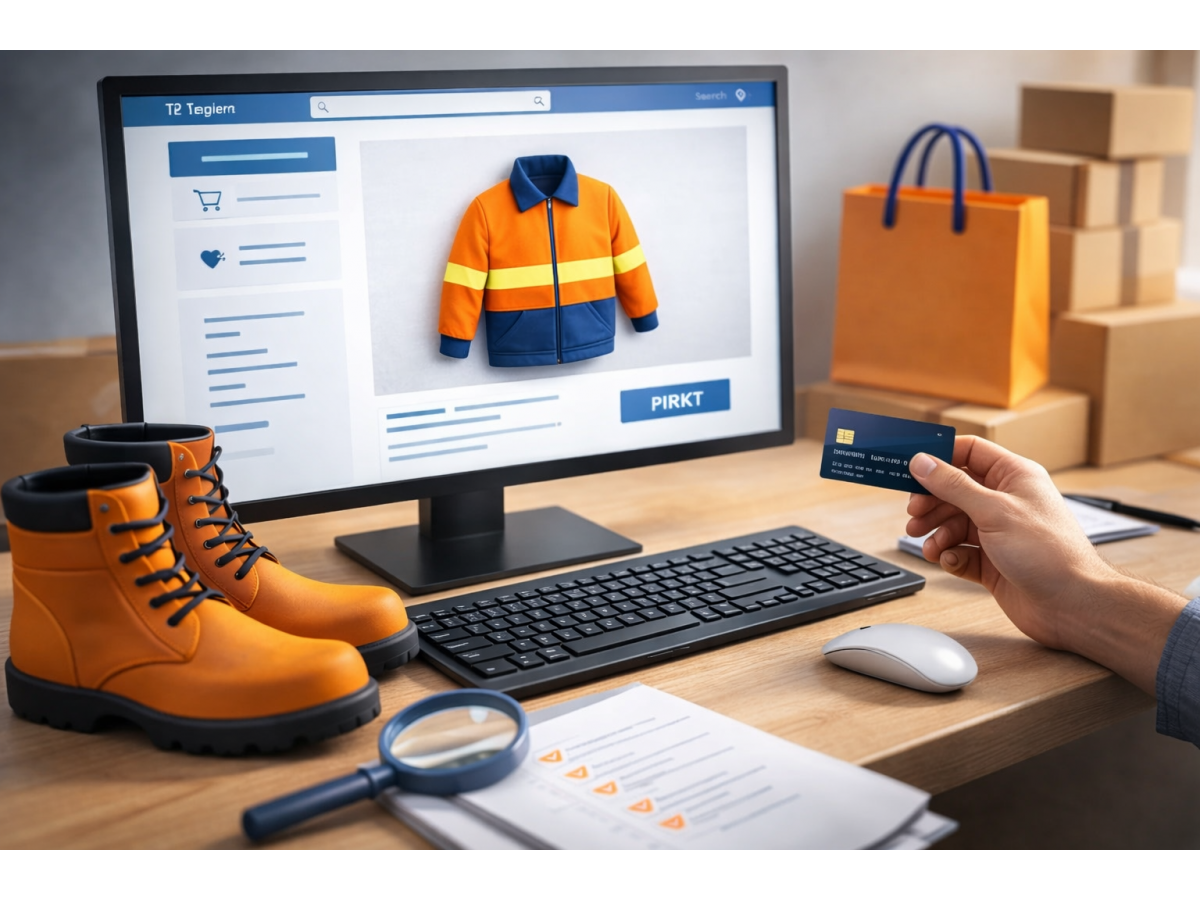
Workwear is often bought in a hurry - after the change of season, the start of a new project or simply because the old set has finally worn out. Online it happens even faster: a couple of clicks, and there are already trousers, a jacket and gloves in the basket. But when it comes to workwear, “fast” is not always “right”. An inappropriate size rubs the whole shift, the fabric does not hold up to the load, and the wrong protection class can mean a real risk.
This is a practical guide to buying workwear online so there are no surprises after delivery. The focus is on materials, cuts, standards, seasons, and also how the companies that outfit teams think.
Why work clothes are often cheaper online
E-commerce of workwear offers professionals three real advantages. First, time: no need to go to the store, wait for a consultant, or search for stock. Second, choice: online, you can usually see a full range of sizes, colors, standards, and variations (for example, the same jacket with different insulation). Third, price: direct deliveries and large volumes often mean a lower price per unit than in retail.
But there is also a trade-off. You can't try on the fabric and "self-sew" it right away. That's why it's important to learn to read descriptions as purchasing specifications, not as advertising text.
Size and fit - the main reason for returns
The size chart is not a formality. The cut of work trousers and jackets varies even within the same size label, because manufacturers anticipate different usage situations: with thermal underwear, with a tool belt, with knee pads, with a margin of movement.
If you work with frequent squatting, climbing stairs, or working on your knees, you don't need a "pretty" silhouette, but a range of motion - elastic inserts, anatomical knees, a higher waist, the right length of the hem. In a warehouse or production, on the other hand, it may be more important that the clothing does not catch on equipment and is not too loose.
Practical: Before ordering, measure your waist and hips, think about the length of the beam and whether there will be an additional layer underneath. If the company is purchasing for several teams, it is worth fixing a “reference model” - one specific model of trousers and jacket that fits the majority, and then re-order the same. This reduces errors and makes assembly easier.
Materials: What Durability Really Means
The word “durable” in a description doesn’t guarantee anything. Look for specific parameters: fabric composition, density, and reinforcements.
Cotton is pleasant and breathable, but pure cotton can wear out faster and take longer to dry during intensive work. Polyester and cotton blends usually hold their shape better, dry faster and are practical for everyday use. If you work with frequent friction (knees, pocket edges, tool belts), reinforcements - double layers, durable fabric in the knees, as well as the quality of the seams - are crucial.
An important detail that many people overlook: pocket construction. Work pants with tool pockets, a ruler pocket, a phone compartment, and reinforced seams can last longer, not because the fabric is “tougher,” but because the load is distributed properly.
Protection levels: when “workwear” is not just clothing
In some industries, clothing is PPE (personal protective equipment) or must meet specific standards. This information should be clearly visible online - certification, class, application.
High visibility clothing
If you work on roads, in logistics, in areas with machinery or in the dark, high-visibility clothing is not a “flashy” thing, but a safety requirement. Check whether the visibility class is indicated and in which zones there are reflective strips. The choice depends on the working environment: sometimes a vest is enough, but for long shifts you often need a full set - jacket and trousers.
For welders: fire resistance and antistatic
Welding and working with sparks require specific protection . Two aspects are important here - the material's resistance to heat and sparks, as well as antistatic behavior, if the environment requires it. Do not assume that "thick fabric" is automatically safe. Look for an indication that the clothing is intended for welding, and check what level of protection is declared.
HACCP in the food environment
In food production and catering, the role of clothing is not only to protect the worker, but also the process. Here, cleaning resistance, hygiene and design that reduces the risk of contamination (e.g. pocket and closure solutions) are important. If the company is subject to audits, it is better to choose clothing designed for a HACCP environment at the time of purchase rather than adapting regular workwear.
Medicine and care
Here, comfort and ease of care are often paramount - lightweight, breathable fabric designed for frequent washing, and a cut that does not restrict movement. At the same time, a uniform visual standard for the department or institution is also important, especially if the staff changes shifts.
Season and layering: the cheapest kit can get expensive
For those working outdoors, clothing is rarely a “one-piece.” It’s more practical to think in terms of a system: base layer, insulation, outer layer. Online, this means looking at whether the jacket is wind and moisture resistant, how warm the lining is, and whether there’s room underneath for fleece or thermal underwear.
If you choose clothing that is too thin for winter, you will compensate with multiple layers, which can compromise your freedom of movement. If you choose a set that is too warm for indoor work, you will be hot, sweaty, and uncomfortable, which is a productivity and health issue in the long run.
Procurement for the team: how to achieve consistent sizes and predictable delivery
The biggest challenge for companies is usually not finding “good pants.” The challenge is repeatability - so that after three months, they can order 12 more of the same ones, with the same sizes, and so that the new employee looks and works to the same standard as the others.
A simple process helps here: choose 1-2 models for each role (e.g. construction, warehouse, welding), fix the color and size matrix, and then reorder. If you need branding on clothing, it's better to plan it right away - logo prints or embroidery usually need to be planned during production, and this affects deadlines.
If you are looking for a supplier that works with both an extensive catalog and customization and fast assembly, the DARTEKS model is exactly for this B2B work - online ordering combined with support by phone, email or messaging channels and the ability to perform simple production and clothing personalization.
Delivery, payment and returns: airbag for purchase
Online workwear is a good solution only if logistics are predictable. Before purchasing, check the delivery terms and conditions, especially if the project starts on a specific date. Payment security is self-evident, but companies often also value document order and the ability to quickly make changes if sizes change.
The return option is not a “backup plan”, it is part of the normal purchasing process. If you order several sizes for fitting, returning allows you to make a choice without risk. At the same time, if the order is with a logo or other personalization, the conditions may differ - it is always worth agreeing in advance.
When buying online is not the best option
There are situations where “straight to the basket” is not the smartest way to go. If a team is introducing a new uniform or class of PPE for the first time, samples and coordination are often needed to rule out errors. Similarly, if the work involves specific risks (heat, chemicals, electrostatic environments), the decision should be based on the requirements, not what is in stock today.
The same goes for individual buyers - if you're changing your profession or work environment, it's better to ask a few questions and choose correctly, rather than ordering a "universal" set that ends up not fitting any real situation.
Workwear is a tool, not a wardrobe. If you approach your online purchase like you would a tool - checking size, material, standards and delivery - you get a set that works with you, not in the way. And next time, ordering will be even easier, because you will already know exactly what will fit your workday.