
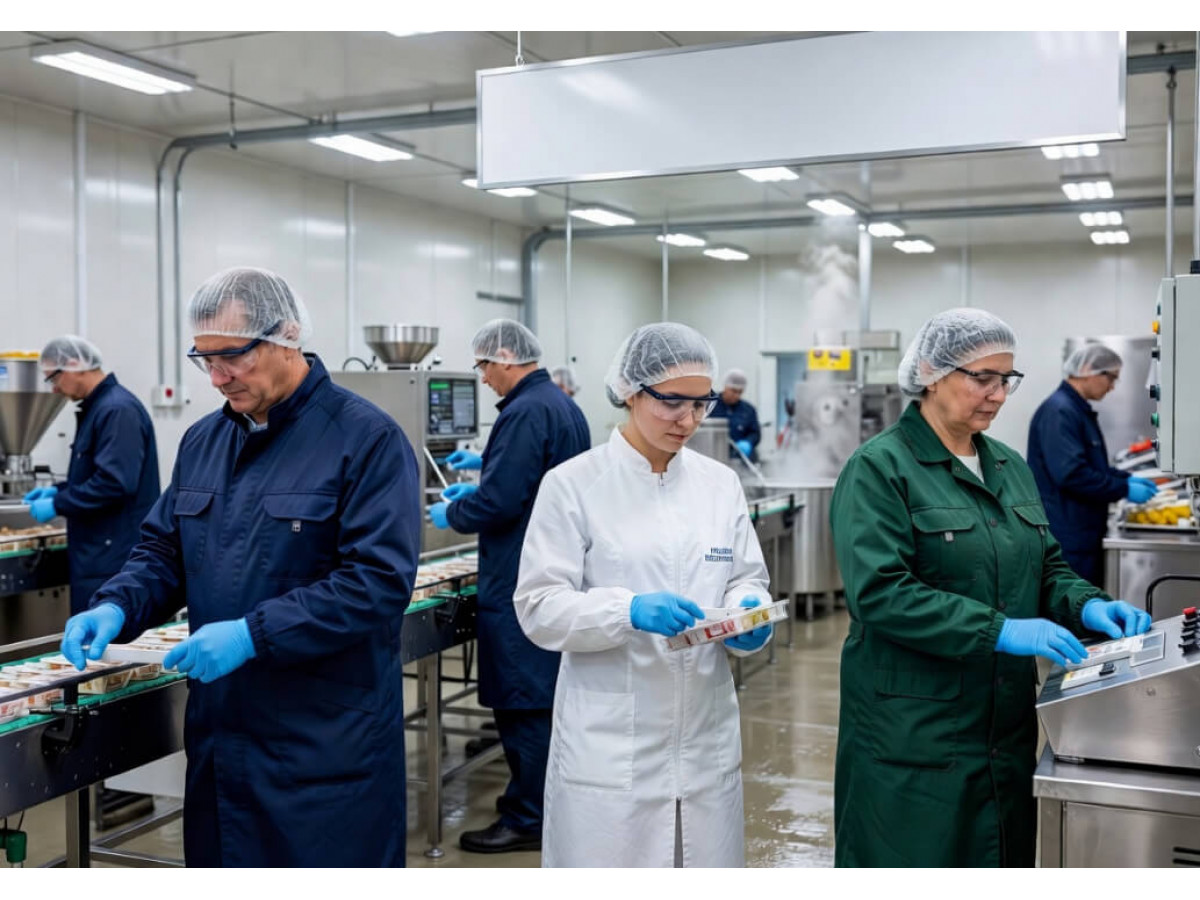
In a production shop, a gown is not just a uniform. If the sleeves get in the way of the line, the fabric quickly absorbs moisture or the fastener creates an additional risk, not only the employee's comfort suffers, but also the discipline of the process. Therefore, work gowns for food production should be viewed as a work tool - with clear requirements for hygiene, durability and everyday usability.
Why work clothes for food production require a different approach
In food production, clothing has a dual function. It protects the worker from the effects of the work environment and at the same time helps protect the product from contamination. That is why the choice cannot be based solely on price or visual appearance.
The gown must work together with the rest of the hygiene system - headgear, aprons, change shoes, washing regime and internal control. If even one element is inadequate, there is a weak link. In practice, this means more changes, greater wear and tear and more complex supervision of personnel.
One mistake is often made when purchasing - choosing a universal model for all areas. This does not always work. In dry packaging, wet production, meat processing or dairy products, the load on clothing is different. Consequently, the requirements for fabric, length, closure and frequency of care will also be different.
The main criteria when choosing a dressing gown
Fabric and its behavior in everyday work
A good fabric for food production is not only durable. It must be able to retain its shape after frequent washing, be dense enough to keep the garment looking neat throughout the shift, and at the same time comfortable enough for active work.
Cotton and polyester blends are often a practical solution, as they combine comfort and ease of care. However, the exact ratio is important. If the environment is hot and the work is intensive, greater comfort will be a priority. If the garment is washed very frequently and a uniform look needs to be maintained for a large team, more attention should be paid to shape retention and the risk of shrinkage.
There is no one perfect fabric for all companies. It depends on the production temperature, humidity, washing regime and how long the gown is worn without changing between shifts.
A cut that doesn't interfere with work
The gown should be loose enough to allow for movement, but not too loose. A model that is too tight restricts shoulder and arm movement, especially in line or packaging work. A model that is too loose creates the risk of snagging and a messy silhouette.
The design of the sleeves is also important. In some processes, long sleeves with cuffs are more suitable, in others - a solution that makes it easier to maintain dryness and freedom of movement. It is not worth looking only in the catalog. You need to evaluate how the gown behaves in a real shift.
Fasteners and details
In food production, fewer parts often mean fewer risks. Hidden fasteners, smooth surfaces and thoughtful design solutions help simplify maintenance and reduce the presence of unnecessary elements in the work area.
Pockets are a good example of where you need to think practically, not by habit. In some positions they are necessary, in others - it is better to abandon them or choose a specific placement. If employees do not need to store items in the gown, unnecessary pockets only complicate hygiene control.
Color and visual control
A white coat is still a common solution, as it allows you to quickly spot dirt and maintain a visually clean standard. However, it will not be the only right option everywhere. Some production environments also use color coding by zone or job group to simplify internal logistics and reduce the risk of errors.
If a company has multiple production areas, uniform clothing coding helps. It makes monitoring easier, speeds up the onboarding of new employees, and helps maintain stricter order without unnecessary administrative burden.
HACCP logic in practice, not just in documents
If a company operates according to HACCP principles, the choice of clothing should be aligned with this system. This does not mean just “buying a white coat.” It means understanding how clothing helps control risks in a specific process.
Food production workwear should be evaluated in this context by how easy it is to maintain, how predictable it is, and whether the design meets the requirements of the work area. For example, if the workwear wears out quickly or loses its shape, this creates an additional burden on the warehouse and personnel management. If the cut is not suitable for the job, employees start pulling up their sleeves, adjusting fasteners, or wearing the garment inappropriately.
Compliance starts with design, but ends with daily discipline. Therefore, the purchasing decision should be made in conjunction with production management, quality control, and, if possible, those who will wear the gowns every day.
When the cheapest option becomes more expensive
From a purchasing perspective, the temptation to save on unit price is understandable. But in food production, the cheapest gown often means higher costs after just a few months. The fabric tears faster, the seams don't hold the load, the dimensions are unstable, and the company has to order more often.
This is especially noticeable for larger teams and shift work. If you can't maintain the same model and size availability, improvisation begins. For some employees, the gowns are too short, for others too wide, and some lack a change kit. As a result, not only comfort drops, but also the overall work rhythm.
It is more practical to assess the total cost over the life cycle. How many washes a robe can withstand. How often it needs to be replaced. How easy it is to reorder an identical model. Is the supplier able to provide serial replenishment without quality fluctuations. These are indicators that are more important than the lowest price on the price list.
Individual purchase or standardized company solution
If a company has a few employees, it may be enough to choose ready-made models from the warehouse assortment. This allows you to quickly assemble a team and implement neat, appropriate clothing without a complicated project.
Standardization becomes more beneficial when the number of employees is larger. Uniform models, uniform colors, consistent sizes, and predictable replenishment reduce the administrative burden. This is especially important for companies with staff turnover or multiple departments.
This is where a supplier who not only sells, but also manufactures and is able to maintain one model in the long term comes in handy. Darteks' approach in such situations is understandable to the business environment - choose a model according to the working conditions, match the fabric, provide adjustments and then repeat deliveries without unnecessary experiments.
What to check before ordering
Before placing a large order, you should not rely only on the technical description. It is much safer to check some practical questions. Does the size range correspond to the real staff. Does the gown retain its shape after washing. Can employees comfortably move around the line, at the tables and in the warehouse. Does the model fit with other mandatory equipment.
The delivery model is also important. A one-time purchase is one thing, but regular supply is another. If the company is growing or increasing volumes seasonally, it should be clear how quickly additional batches can be received and whether the same quality will be maintained.
Another important point is personalization. Not every food production area has a logo as a priority, but in certain processes and employee categories, a unified corporate identity helps maintain a professional image, especially during visitors or audits. Here too, you need to look at it practically - personalization should not interfere with care or occupational safety.
A good robe makes management easier
For a manager, good work clothes mean fewer minor problems in everyday life. Fewer complaints about uncomfortable cuts. Fewer urgent replacements. Less chaos with sizes and reorders. This directly affects work discipline, especially in environments where every deviation from procedure is costly.
For an employee, a good lab coat means something simple - he can concentrate on his work. If the clothing does not cause excessive sweating, does not restrict movement and withstands the strain of a shift, the accuracy of work also increases. This connection between comfort and productivity is often underestimated, although it is precisely this that determines whether the uniform will be just a mandatory purchase or a real work tool.
When choosing gowns for food production, the safest route is not to look for a universal “best model”, but to find a solution that precisely matches your environment, washing regime and team. Then the clothing starts working for the company, instead of requiring constant compromises.