In a food factory, clothing is not a form of appearance. It is a tool for hygiene, safety and work continuity. If work clothes for a food factory are chosen incorrectly, the consequences are usually very practical - a higher risk of contamination, uncomfortable work in shifts, faster wear and tear and constant problems with replacement, washing and size availability.
That is why the purchasing decision in this category should not be based solely on the price per unit. In food production, the whole package is important - fabric, cut, type of closure, color organization, compliance with HACCP requirements and the ability to ensure the same quality even when the team needs regular replenishment.
What tasks should work clothes for a food factory meet?
The first question is not about the model, but about the work environment. Do employees work in a dry area, a wet area, a cold room or a packaging line? Does the work take place on raw materials, finished products or in the sanitary processing stage? This directly affects what kind of clothing should be worn.
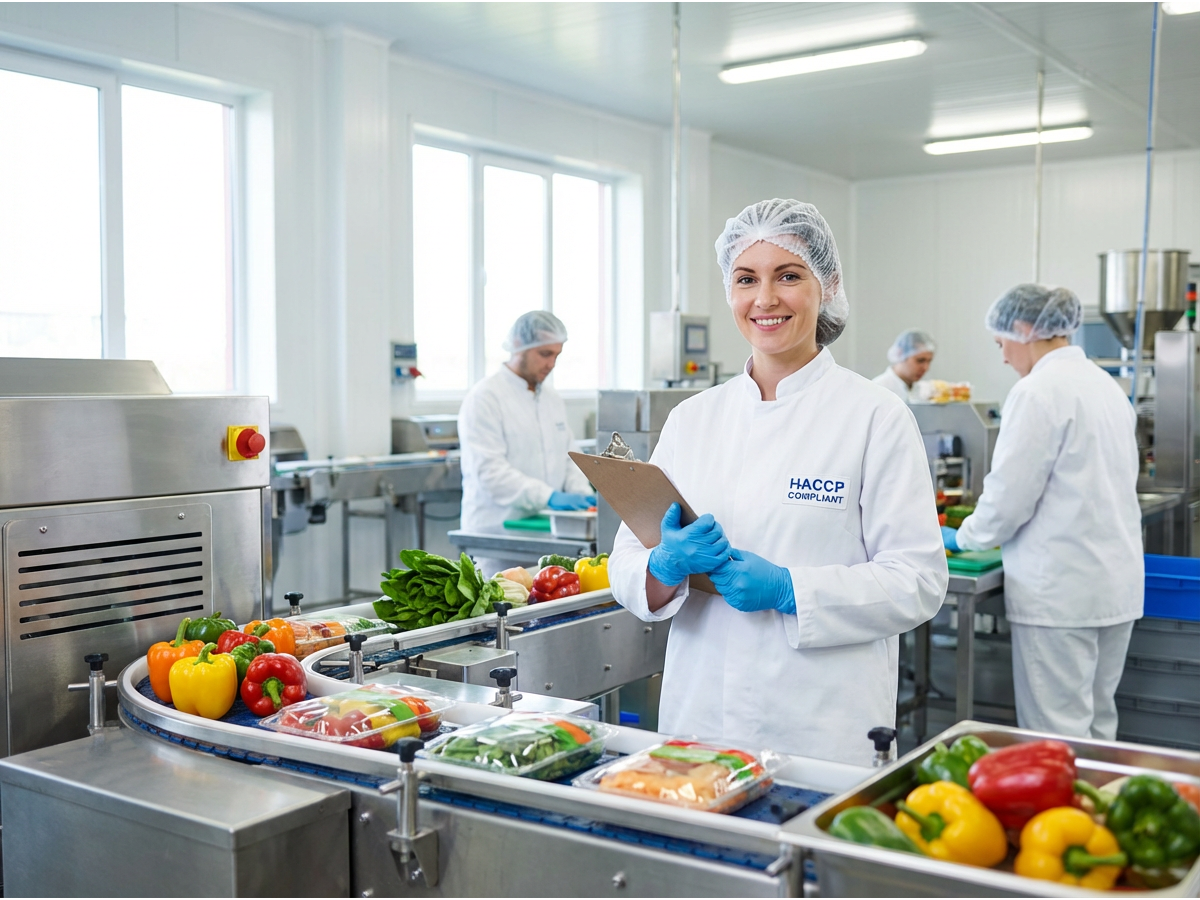
Workwear for food processing plants should provide a hygienic barrier between the worker and the product, while allowing the person to work a full shift without discomfort. This means that the clothing should be easy to care for, resistant to frequent washing, sufficiently breathable and not restricting movement at lines, tables and equipment.
It is also important to understand that a single solution for the entire company is not always the best solution. A shop floor operator, a quality controller, a warehouse worker and a sanitation worker all work in different conditions. If everyone is bought identical clothing just for the sake of simplicity, either comfort or durability often suffers.
Hygiene and HACCP requirements are not a formal requirement
In food production, clothing has a direct impact on risk control. Therefore, in practice, preference is usually given to models with a simple design, without unnecessary decorative elements, with a minimum number of external pockets or none at all. The fewer places where dirt can accumulate or foreign objects can get caught, the safer the daily process.
Closures are also an important detail. Depending on the requirements of the workshop, concealed snaps or zippers with a flap may be more suitable to reduce direct contact with the work environment. Sleeve and cuff solutions should be such that they fit well and do not interfere with work, but at the same time do not pose a risk of contact with the product or equipment.
Color has a practical meaning. White clothing is still a common solution, as it helps to quickly notice dirt and maintain a high level of visual hygiene discipline. However, this is not optimal in all workshops. In certain areas, it is justified to divide the color into sections to make it easier to control movement between clean and dirty areas. Such an approach helps not only in auditing, but also in daily management.
Fabric determines how long clothing will last
One of the most common stumbling blocks in purchasing is overly simplistic fabric selection. The cheapest fabric is not always the most economical solution. If it quickly loses its shape, shrinks, fades or does not withstand intensive industrial washing, the real cost price per use cycle becomes higher.
Food processing plants typically require fabrics that will hold up after repeated washing and drying, are good at wicking away heat, and are dense enough for daily use. Cotton and polyester blends often provide a good balance between comfort and durability. In environments with high humidity or high levels of movement, it is important to assess whether the material is too heavy and whether it will remain comfortable to wear throughout the shift.
There is no one right number that fits all. A lighter fabric may be suitable for warm rooms and packaging areas, while a denser material will be more justified for more intensive processes or combined functions, where the garment must withstand greater mechanical stress. That is why it is worth evaluating not only the catalog, but also the real working conditions before ordering.
A cut that doesn't interfere with work
If an employee is constantly adjusting their coat, pulling down their sleeves, or feeling tension in their shoulders during their shift, productivity will plummet. It happens faster than you often want to admit. In a food service environment, clothing should allow for freedom to reach, lift, turn, work at a table, and move between stations without undue effort.
This means that sizing and fit are just as important as the fabric. Standard sizes without the ability to adjust lengths or volumes often cause problems for teams with different heights and body types. On paper, this may seem like a small thing, but in practice, poorly fitting clothing increases wear and tear at seams, leads to complaints, and increases the number of substitutions.
Therefore, for companies with regular staff turnover or larger teams, a solution that can ensure consistent size availability and repeat orders in the same quality is more beneficial. This is where the manufacturer's capacity and serial delivery capabilities become a significant benefit, not just an additional service.
What work clothes are needed in practice for a food factory?
It is usually not a single piece of clothing, but a system. The basic set often includes a gown or jacket , trousers, headgear and, depending on the area , an apron . Some processes also require thermal layers if the work is carried out in colder temperatures, or lighter options for warmer rooms.
Compatibility with other protective equipment is also important. If workers also wear gloves, the sleeve design should be practical. If safety footwear is required, the length and cut of the trousers should work with them. If the workshop is exposed to high humidity or splashes, the top layer should be easy to maintain and sufficiently durable.
Smaller teams sometimes try to get by with a one-size-fits-all model for all positions. This can work if the process is simple and the working conditions are similar. However, in larger manufacturing companies, a zoned approach, where clothing sets are tailored to specific tasks, yields better results.
What to check before purchasing
The safest way is to evaluate not only the price and design, but the entire service life. How often will the clothing be washed? Can the supplier provide the same model even after several months? Is the size matrix sufficient for the entire team? Is it possible to apply a logo without compromising hygiene and care requirements?
Procurement specialists and production managers should also look at the stability of supply. If a shop requires regular replenishment, irregular deliveries create unnecessary administrative burden and hinder standardization. Another practical matter is reserve planning - in food production, clothing wears out predictably, so orders should be placed in advance, not when a shortage has already occurred.
If a company wants a unified corporate image, personalization should be done thoughtfully. A logo or embroidery can strengthen a professional company image, but in a food environment it should not create additional risks or complicate care. Here, not only the visual solution is important, but also the technology with which the labeling is done.
When the cheapest option becomes more expensive
The cheapest offer often only looks attractive at the time of ordering. If the clothing wears out after a short time, loses its shape or causes dissatisfaction in the team, repeat purchases, urgent replacements and small but expensive operational problems begin. In food production, this means not only costs, but also management time.
It is more practical to calculate the total costs over a certain period. In this view, higher quality fabric, better cut and stable replenishment often result in a lower cost level than an initially cheaper but unstable solution. That is why professional workwear should be viewed as a tool for work organization, not as a one-time purchase.
For companies that value predictable quality, it is beneficial to work with a supplier that can provide not only a catalog, but also production control, customization, and repeatability. Darteks is a practical choice for companies that value compliance, fast delivery, and consistent quality without overpaying.
Good workwear for a food factory does its job quietly - it helps maintain hygiene discipline, reduces daily disruptions, and allows the team to focus on production, not inconvenience.