
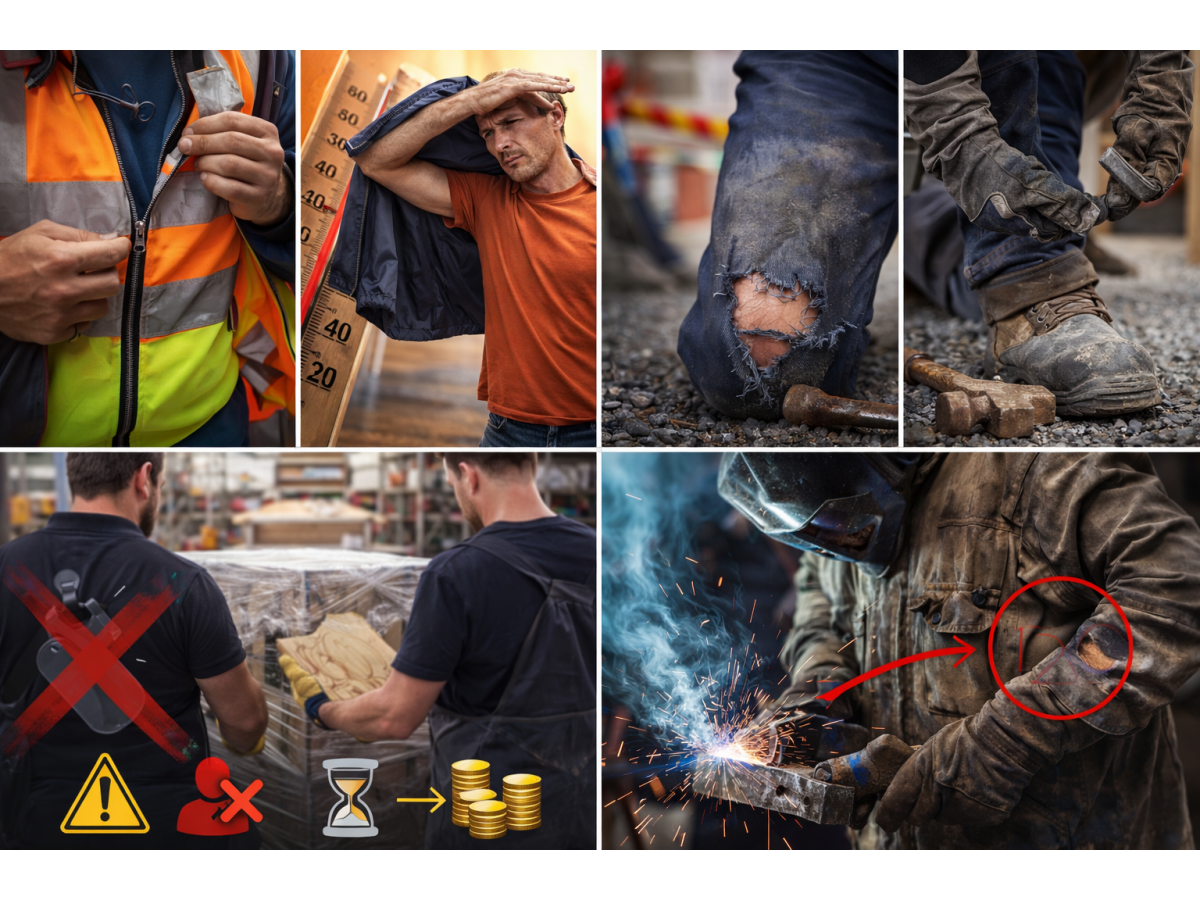
The first sign that protective clothing is not chosen correctly is usually not an accident. It is a small thing that is repeated every day: an employee takes off his jacket because it is "hot"; unzips his reflective vest because it is "disturbing"; or looks for another set of overalls because the seams are pinching, the pockets are not where they should be, and the knees wear out within a month. These "small things" produce real costs - lower discipline, higher risk, slower work and more frequent replacements.
Protective clothing is not just clothes. It is a work tool with a specific task: to protect a person, to help meet the requirements at a site or factory, and at the same time to allow you to work quickly, comfortably and without unnecessary effort. Therefore, the choice is not about what looks "ok" in the catalog, but about what actually withstands your working conditions.
What protective clothing should solve in your company
On the purchasing side, there are typically three goals: safety and compliance, comfort (so that the garment is worn, not sitting in the closet), and long-term cost control. All three are related.
If the clothing is too heavy or doesn't breathe, the employee will adjust it themselves - unbutton it, fold it, change it to a private one. If the clothing is not sufficiently visible, not designed for welding or does not form a barrier against contamination in the food area, the company risks an incident, sanctions and work suspension. And if the fabric and fittings do not hold the load, you pay twice - for the purchase and for the downtime when the person has nothing to wear.
It is good practice to start not with a model, but with work scenarios: who works outside, who works indoors; are there sparks, chemicals, dust, oils; is there traffic and forklifts; are there hygiene areas; what is the seasonality and length of shifts. From this, the requirements for material, cut and certification follow.
Protective clothing by risk type: where mistakes are most common
High visibility (hi-vis) clothing
Hi-vis is not just a color. It is visibility day and night, the correct placement of reflective elements and their durability after washing and rubbing. In logistics, road construction, ports, and areas with road transport, the most common mistake is "let's take vests for everyone." A vest is a good solution for guests or occasional work, but for everyday work, a hi-vis jacket , trousers or overalls are much more effective - visibility is 360 degrees, not just on the upper body.
Another classic stumbling block is seasonality: in winter, the hi-vis layer remains under a dark outer jacket, and visibility disappears. Therefore, a system must be planned where visibility is present in the outer layer even in the cold season.
Flame-resistant and antistatic (FR/AS) protective clothing for welding and metalworking
For welders and those who work with grinding, sparks and hot surfaces, choosing clothing is not a place to compromise. The most common mistake is to think that "thicker = safer". Clothing that is too heavy makes you tired, and fatigue increases your chances of making mistakes. It is better to choose clothing with adequate FR/AS protection and a construction that does not retain more heat than necessary.
It is also important that pockets, closures and cuffs do not collect sparks. For example, open pocket edges and unsuitable fittings can become a place where glowing particles can get in. Well-designed workwear reduces this risk with overlaps, protected closures and thoughtful seam placement.
Protection against dirt, oil and wear (general industry, construction)
Two things determine the outcome here: the strength of the fabric and the construction. If the knees and elbows are not reinforced, the pants will wear out faster than the budget would like. If there is no space for tools, the worker will carry them in pockets that are not designed to hold the weight, and the seams will tear.
Wear resistance is not just "thick fabric". It is also the right cut for movement: pleats, elastic inserts, sufficient length in the back, adjustable trouser legs. If clothing pulls or pushes when moving, a person works slower and seams are more likely to tear.
HACCP and hygiene clothing for food and HoReCa
In food production and the kitchen, the role of clothing is not only to protect the worker, but also the product. This means predictable details: minimal risk of external elements (such as parts that can come off), easy washing, a suitable cut that covers and does not fly, and clear zoning discipline.
The most common mistake is to mix "warehouse" and "production" needs in the same set of clothes. Warehouse often needs durability and pockets, production - cleanliness and controlled details. If you try to put one on top of the other, both sides suffer.
Medicine and care
Here, comfort is productivity. Long shifts, frequent movement, number of contacts with patients or customers - clothing should be light, breathable, easy to care for and with a reasonable pocket layout. Too tight a cut is tiring, while too loose looks unkempt and distracting. A uniform uniform with a clearly visible identity improves customer trust and internal order.
How to buy protective clothing without surprises
When purchasing, it's worth thinking like an operations manager, not a store buyer. The main question: after 3 months, will the clothing still function and look professional enough to want to wear?
Start with the division of roles. At one facility, there may be builders, electricians, technicians, drivers and a manager who also goes to the client. They do not need identical clothes. They need a unified system: colors, logo and common visual code, but different protective features and details.
Next comes the stability of sizes and cut. If your company has a rotation and needs to buy more, it is important for you to be able to order the same model in half a year and get a predictable result. This is especially true for B2B staffing, where one team needs to look unified.
And finally - care. If the clothing requires complex care, it will not be followed in practice. As a result, reflective tapes are damaged, the fabric shrinks or its properties are lost. When choosing, always compare the care requirements with the actual washing regime in the company.
Quality that affects safety: details you only see after a week of work
Safety clothing may look similar, but differ in points that only come to light during use.
Seams and reinforcements come first. The areas that receive the load - beams, knees, pocket corners, shoulders - need to be designed so that they don't tear with every squat or tool pull.
Fasteners and fittings are second. A zipper that gets caught costs you time and nerves during the workday. Buttons and snaps that don’t fit the environment can become a safety hazard. Here’s where the trade-off comes in: the more pockets and details, the more potential places that can get caught or worn out. The work of your employees determines whether the details are an asset or a hindrance.
Visibility elements and their durability are the third. If the hi-vis tape becomes dull or starts to peel after washing, the garment no longer fulfills its primary function, even if the fabric still holds up.
Uniform form as a tool: security plus corporate image
In many companies, protective clothing is also corporate clothing. This is not "marketing" in the classic sense - it is an operational benefit. A uniform uniform facilitates access control at facilities, improves customer confidence and reduces disputes about who is allowed in the area.
Logo placement and embroidery only work if the base garment is stable: the right place, the right size, the right fabric that can withstand washing. Here again, long-term thinking comes into play - it is better to match the pattern and color scheme once than to "improvise" for each order.
If you need a supplier that can provide both a ready-made assortment and customization and regular replenishment, you can do it in one flow, for example, with Darteks.eu - from model selection and materials to logo application and serial orders.
Practical approach: how to check the selection before a large order
The safest way to avoid mistakes is to do a little test in real work. Choose 2-3 models for each critical role and give them to the people who work in the most intensive conditions. One week often says more than any description.
Don't just rate "likes/dislikes." Look to see if reflective elements remain clean and visible, if the garment doesn't absorb too much dirt, if pockets are used as intended, and if there are any new habits - like not putting on a jacket because it's tight at the neck. These are all signals about fit and ventilation.
And remember one pragmatic truth: protective clothing only works if it is easy to wear. You can buy the highest level of protection, but if the clothing hinders movement or overheats, a person will find a way to "get around" it. A good choice is one that combines the requirements with the comfort of real change - then safety becomes a daily routine, not a forced rule.