
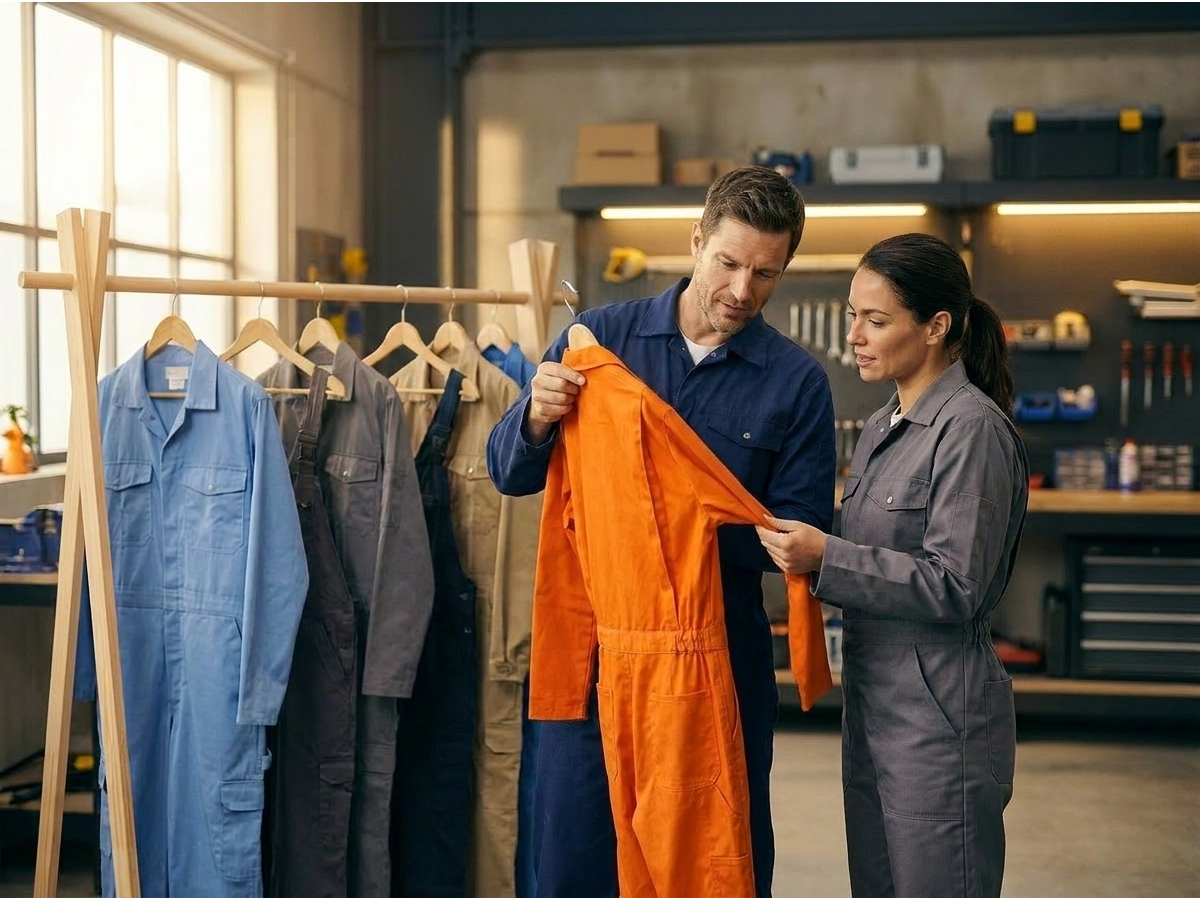
If your workday is spent in dust, oil, sparks, cold or constant movement, the question of how to choose work overalls is not about appearance. It is a question of safety, work pace and costs. An incorrectly chosen overalls wears out quickly, hinders movement, is poorly ventilated and ends up costing more than it initially seemed.
Overalls are one of those items where the cheapest option is often not the most economical. If the garment tears at the seams, fails to withstand washing, or is unsuitable for the work environment, the company loses not only on replacement costs. Losses also arise from downtime, employee discomfort, an uneven visual image, and in some cases, from failure to comply with safety requirements.
How to choose work overalls according to the work environment
The first selection criterion is always the working conditions, not a universal model. In construction and assembly, wear resistance, reinforced knees, pocket functionality and freedom of movement are important. In warehousing and logistics, lightness, flexibility and comfort during long shifts are often more important. In welding or metalworking, on the other hand, the overalls must already meet specific protection requirements - with fire-resistant and anti-static properties, if this is determined by the risk of work.
In food production and HoReCa environments, another principle is relevant - hygiene, easy care and suitability for the specific process. The logic of ordinary industrial workwear does not apply there. In medicine and care, freedom of movement, breathable fabric and resistance to regular washing come to the fore.
Therefore, before choosing a model, you need to answer three simple questions. What risks the worker faces every day, how intense the movements are, and how often the clothing will be washed. These factors most often determine whether the coverall will last for months or just a few weeks.
Fabric determines more than price
Many buyers look at price first, but in workwear, the composition of the fabric often says more than the price tag. When you need durability and longevity, a cotton/polyester blend is usually a good choice. Cotton provides comfort and breathability, while polyester helps maintain shape, color, and wear resistance.
Pure cotton can be pleasant to wear, especially in warm weather, but in an intense industrial environment it may not always be the most practical choice. It can dry more slowly and lose its original appearance more quickly. On the other hand, a fabric that is too synthetic will sometimes be durable, but less comfortable for long-term work. A good balance is more important than theoretically higher durability.
Another thing to consider is the fabric density. Thinner fabric is suitable for indoor use, warm weather, and high-intensity work. Thicker fabric usually lasts longer and provides better protection from mechanical stress, but it can be heavier and hotter. If a team works both indoors and outdoors, it is often worth considering separate solutions for the season and type of work rather than looking for one universal model.
The fit and freedom of movement are no small thing
Overalls that make it difficult to squat, raise your arms, or walk freely become a productivity problem in practice. That's why the fit is as important as the fabric. An employee may put up with uncomfortable clothing for one day, but in the long run it means fatigue, imprecise movements, and a greater risk of wear and tear.
It is necessary to assess whether the model has ergonomically designed knees, sufficient space in the shoulder area, adjustable cuffs, elastic inserts or other solutions that facilitate movement. If the work involves frequent bending, crawling or working on the knees, knee pockets for inserts and additional reinforcements become very important. If the employee works on ladders, platforms or in narrow spaces, a jumpsuit that is too wide or awkwardly fitting can even interfere with safety.
Another practical issue that often arises for companies with multiple teams is dimensional stability. If a supplier cannot provide a consistent sizing system and repeat deliveries of the same model, there will be problems with replenishment later. Therefore, it is important to think not just about a single purchase, but about long-term supply.
Level of protection - just as much as you need, but no less
Not every job requires a specialized protective coverall, but in areas where there are specific risks, compromises are not acceptable. If the work environment requires high-visibility clothing, then a model with appropriate signal colors and reflective elements should be chosen. If there is a risk of heat, sparks or electrostatic discharge, certified solutions with appropriate properties are required.
A common mistake is to overpay for features that are not necessary for the job. For example, a warehouse worker does not need the same level of protection as a welder. But an equally costly mistake is to choose a model that is too simple for an environment where a certain level of compliance is required. The right approach in purchasing is to link clothing to a real assessment of job risks, not assumptions.
If a company has multiple job groups, it doesn’t make sense to buy the same overalls for everyone just for the sake of convenience. Standardization is a good thing, but only as long as it doesn’t compromise functionality. It’s much more efficient to maintain a unified visual identity while adapting models for different job tasks.
Season, temperature and work intensity
In Latvian conditions, seasonality is essential. What works well in May may be completely unsuitable in January. A jumpsuit suitable for summer is usually lighter, more breathable and has better ventilation. In winter, you should look at thermal insulation, protection against wind and moisture, but at the same time you should not forget about freedom of movement.
Here too, everything depends on the intensity of the work. An employee who is on the move most of the shift will quickly overheat in too warm clothing. On the other hand, a person who works outdoors in stationary positions for a long time will need more serious protection against the cold. The same winter jacket or overalls do not work equally well in these two scenarios.
Therefore, in many cases, the right choice is not the thickest model, but the logic of layering. An outer work suit combined with a suitable underlayer often gives a better result than a heavy and non-breathable solution. This is especially relevant for crews working in changing weather conditions.
Practical details that pay off every day
The number of pockets in itself does not guarantee anything. What matters is whether they are placed wisely and whether the employee will actually use them. Tool pockets, space for a phone, documents, a ruler or an ID card can make work much easier. However, if pockets are in the wrong place, they only create unnecessary volume and wear out faster.
The quality of the closure, the quality of the seams and the reinforcements in the stress areas are also of great importance. The knees, elbows, seat, zipper and pocket edges are the places where the quality differences become visible the fastest. If the overalls are intended for intensive work, these are the areas where you should not skimp.
Another factor is care. If the clothing is washed frequently and in large quantities in the company, you should choose materials and finishes that retain their shape and function after repeated washings. Otherwise, even a good model will quickly lose its value. This is where the manufacturer's quality control and stable series production give a real advantage.
How to choose work overalls for company procurement
For an individual buyer, personal comfort and protection are the main considerations. In corporate purchasing, there are more criteria. You need to think about a unified visual image, repeat delivery options, size availability, adaptation to different job groups, and total costs over the entire life cycle.
That is why the professional approach is not to start with a model, but with a job analysis. Which areas have the most wear, whether a logo print or embroidery is needed, how often will there be replenishment, whether there will be seasonal changes, and how quickly delivery is required. If these questions are discussed at the beginning, the number of errors and unplanned expenses will be reduced later.
For companies that want an organized and long-term profitable workwear system, cooperation with a supplier that is able not only to sell a finished product, but also to ensure the selection of models according to working conditions, customization and regular replenishment usually works best. In this approach, workwear becomes not a one-time purchase, but a manageable resource. This is exactly the approach that Darteks customers in various industries appreciate in practice.
The most common mistake is choosing based on first impressions.
A good work suit doesn't always look the most impressive in a catalog. The right choice is usually the one that best suits the specific job, washing regimen, season, and employee's daily workload. If the model is comfortable, durable, and meets safety requirements, it reduces complaints, improves discipline, and helps maintain a professional company image.
If you need to make a decision right now, start not by asking which overalls are the most popular, but by asking which one will best withstand your workday.