
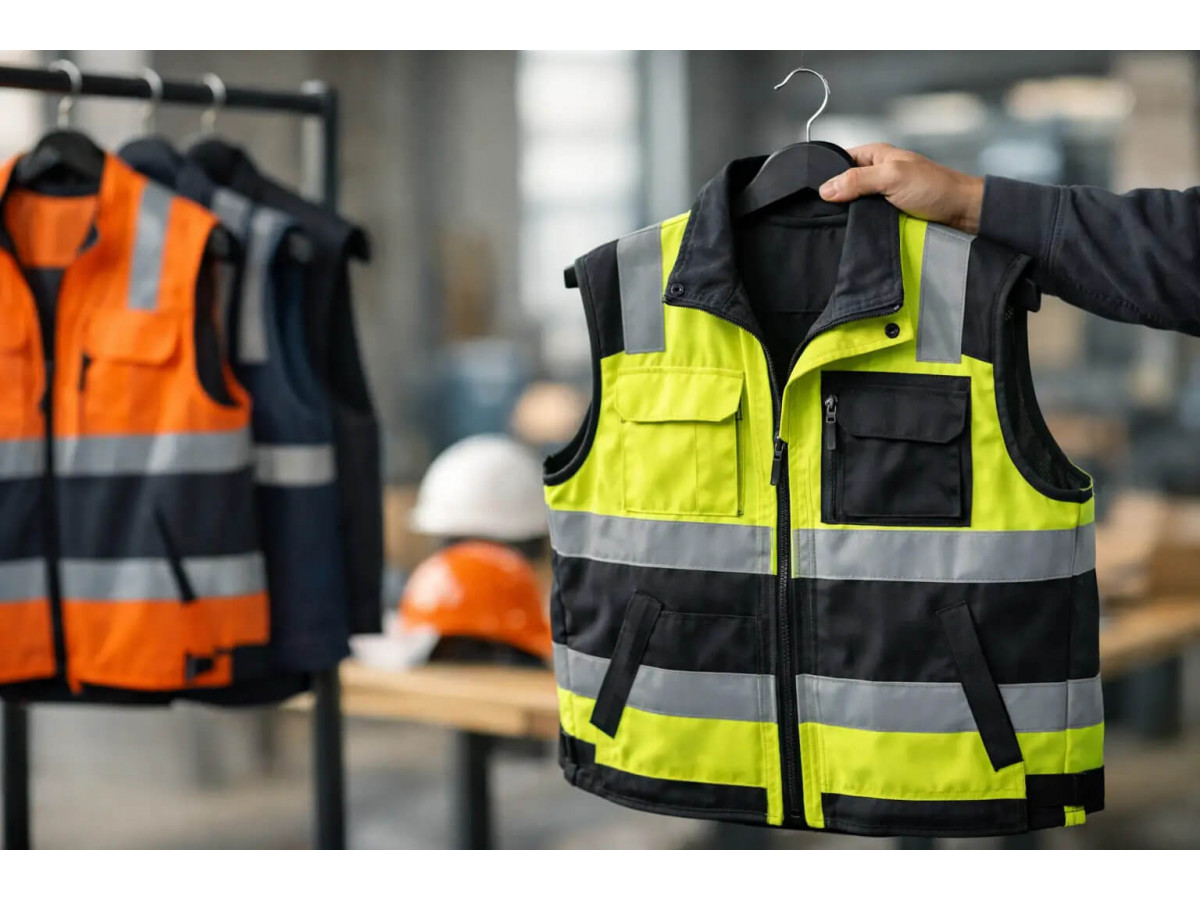
A work vest is usually only appreciated when it is chosen incorrectly. Too narrow - it hinders movement. Too thin - it does not protect in a cold warehouse or outside on a site. Without the necessary pockets - it slows down work. That is why the question of how to choose a work vest is not just about appearance. It is about safety, work pace and how long the clothing will last in daily workload.
For procurement specialists and construction managers, the vest often seems like a secondary element between jackets, trousers and overalls. In practice, it is often one of the most frequently used pieces of workwear - especially in logistics, construction, warehouses, service and production. If the vest is selected according to the working environment, the employee gains freedom of movement, the necessary warmth and quick access to tools or documents. If the choice is based only on price, the compromise usually appears in the first few weeks.
How to choose a work vest according to the work environment
The first criterion is not the model, but the environment in which the vest will be used. Outdoor work in the fall or spring usually requires an insulated vest with a windproof outer fabric. Indoors, where the worker moves a lot, a lighter vest that does not heat up and does not restrict movement often works better.
In construction and road works, visibility is often crucial. A simple dark work vest is not enough - a high-visibility model with reflective elements and appropriate fluorescent color is needed. When working with machinery, in the dark or in a high-traffic area, visibility is not an added bonus, but a basic requirement.
In manufacturing and warehouses, a balance between durability and comfort is often important. The vest must withstand friction, frequent pulling on and off, as well as the load of pockets. In food production, medicine or the HoReCa segment, however, the requirements may be different - hygiene, easy care and compliance with a specific work process become more important.
If employees work in welding, metalworking or in environments with increased risk of sparks, heat or electrostatics, a regular work vest will not work. In such situations, specialized clothing with appropriate protection should be chosen. There is no room for guesswork here - you must be guided by the risk assessment and occupational health and safety requirements.
The material determines how long the vest will last.
For a work vest, the material is as important as the cut. A thicker fabric usually provides better wear resistance, but can be heavier and stiffer. Lighter materials will be more comfortable for active work, but will not always withstand intense mechanical stress.
Cotton and polyester blends work well in everyday industrial environments. Cotton improves comfort and breathability, while polyester helps maintain shape, color, and durability after frequent washing. If a vest is used every day and washed regularly, the durability of the fabric directly affects the overall cost. A cheaper model that quickly loses its shape or starts to tear at the seams will cost more in the long run.
For insulated vests, attention should be paid not only to the outer fabric, but also to the filling and lining. A vest that is too thick may be good for standing work in the cold, but uncomfortable for those who move around a lot. On the other hand, a model that is too thin will not fulfill its task. Therefore, you should always consider whether the work is static or dynamic, indoors or outdoors, and whether the vest will be worn over a base layer or under a jacket.
Cut and size affect productivity
A vest should allow you to work, not force you to adjust to the clothing. A vest that is too tight restricts arm movement, makes it difficult to bend over, and creates tension in the shoulder area. A vest that is too loose will catch on equipment, look unprofessional, and wear out faster in certain areas.
When choosing a size for a team, a mistake often occurs when you are guided only by everyday clothing. A work vest is worn over a T-shirt, sweater or other work jacket, so layering should be taken into account. In the cold season, a larger margin is needed, but it should not turn into excess volume.
If a company orders vests for multiple employees, it is worth standardizing not only the model but also the fitting approach. This reduces incorrect sizes, returns, and unused stock. This is especially important for companies with regular replenishment and uniform corporate clothing.
Pockets, closures and details are not small things
Good work clothes speed up your daily work. Poorly thought-out details slow it down. That's why a work vest should be evaluated not only by fabric and price, but also by functionality.
If an employee needs to carry a phone, documents, a marker, a knife, a tape measure or small tools with them on a daily basis, the placement of the pockets is crucial. Too few pockets create chaos. Too many or incorrectly placed pockets make the vest heavy and uncomfortable. The most practical solution is usually a balance - a sufficient number of pockets with logical access and secure closure.
A zipper is usually more convenient for quick use, especially if the vest is often put on and taken off. Buttons may be acceptable in some industries, but they are usually slower and less practical for intensive work. If the work is done in cold or windy conditions, an extended back, a higher collar and a quality fastener that will not wear out after one season are useful.
Reflective details are not only needed in road construction. They are also useful in warehouses, service areas and places where machinery moves. Meanwhile, reinforced seams, wear-resistant inserts and high-quality fittings are important in almost any industry.
When you need a high-visibility or specialized work vest
Not every work vest is suitable for every risk. If you work in areas with traffic, poor lighting conditions or on the road, you should choose a high-visibility vest with the appropriate level of protection. It is not only the bright shade that is important here, but also the placement of the reflective strips and their suitability for the intended use.
If the environment involves a risk of fire, sparks or electrostatic discharge, a flame retardant or anti-static vest is required, not a standard model. Some companies mistakenly try to apply one universal solution to all roles. This rarely works. A warehouse worker and a welder may have the same brand or color, but not the same protective properties.
In the food sector and other hygienic environments, the main focus is on the fabric's ease of care, cleanliness and suitability for the process. There, a simpler, easy-to-care-for model without unnecessary parts that collect dirt will often be preferred.
Compare the price with the time of use, not just the time of purchase
When purchasing workwear for a larger team, price is always important. However, the decision should be made based on the total cost, not just the lowest offer. If the vest quickly loses its shape, fades, tears, or employees don't wear it because it's inconvenient, the savings disappear very quickly.
It is worth considering how often the vest will be worn, washed and subjected to what stress. Day shifts, outdoor facilities and technical work will see much greater wear and tear than occasional use. In such cases, a higher quality model with a stable fabric and proven construction is often the more economically sound choice.
For companies with a uniform, long-term availability is also important. If a model is no longer available after three months, replenishment becomes difficult. Therefore, it is safer to cooperate with a supplier that can ensure not only a one-time delivery, but also repeated production, logo application and dimensional continuity. In this approach, workwear becomes a manageable system, not a separate purchase. That is why many companies choose solutions from a single manufacturer and supplier, such as Darteks.
How to choose a work vest for a team, not just one person
If you are buying a vest for yourself, it is enough to focus on your work and comfort. If you need to outfit a team, the criteria become broader. You need to think about job differences, seasons, stock levels, backorders, and the company's visual image.
The most practical solution is often not one size fits all, but two or three coordinated models depending on the job role. For example, a lighter vest for warehouse personnel, a insulated vest for foremen and outdoor workers, and a high-visibility option in traffic areas. This reduces compromises and helps ensure that the garment is actually used.
Brand representation is also important. A uniform color, a high-quality cut and a correctly applied logo are not just a visual issue. They create an impression of the company's discipline and reliability at customer sites, in the production plant and in the delivery processes. At the same time, visuals should not replace functionality. A work vest is first and foremost a tool.
Before confirming your order, you should ask yourself some very practical questions: where the vest will be worn, how long during the shift, what items should be kept in the pockets, whether increased visibility is needed, whether the model will be available again and how it will behave after regular washing. If you have clear answers to these questions, your choice will also be much more accurate.
A properly chosen work vest is not a random purchase. It helps an employee move freely, work more safely, and maintain a professional appearance throughout the shift. If the vest meets the real working conditions, it does not need to be trained - it simply works with the person.