
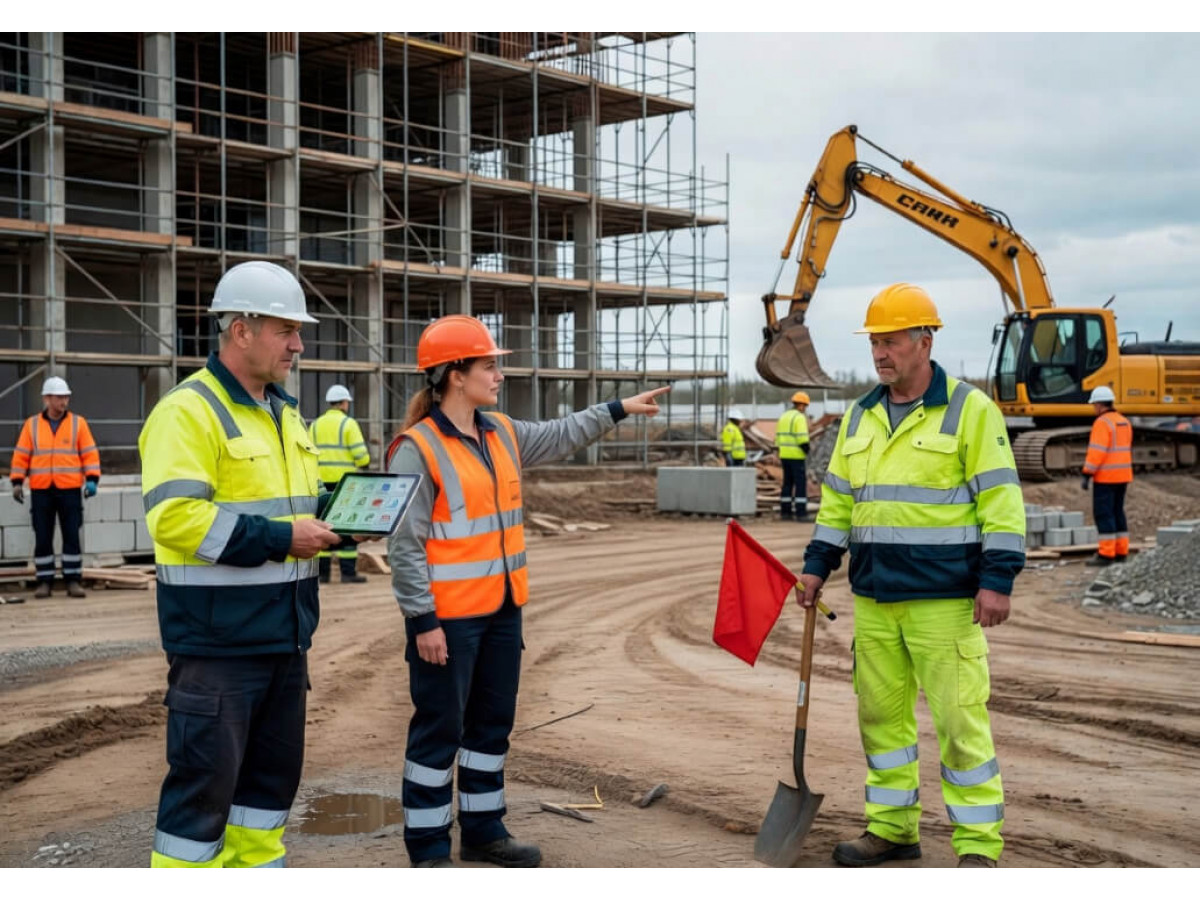
If you make a mistake with high-visibility clothing during procurement, the problem usually occurs not in the warehouse, but on site - in the dark, in the rain, with moving equipment or in road traffic. Therefore, the hi vis clothing standards guide is not a formal requirement for documentation. It is a practical tool to reduce risk, avoid inappropriate purchases and ensure that the team is truly visible where it matters.
Why the Hi Vis Clothing Standards Guide is Important in Purchasing
High-visibility clothing is often perceived too simplistically - bright fabric and reflective stripes are enough. In real work, this is not enough. Visibility is determined not only by the color, but also by the area of the fluorescent material, the placement of the reflective material, the construction of the garment, wear and how the garment is worn in combination with other layers.
For the employer, this means one thing - you can't choose based on price or visual impression alone. If the vest is too small, it is left open. If the jacket is too heavy, the employee takes it off. If the reflective material wears out rapidly in rainy conditions, the initial compliance no longer guarantees anything. Standards help to compare products based on measurable criteria, not assumptions.
The main standard for high visibility clothing
In Europe, the most important reference point is EN ISO 20471. This standard sets out the requirements for high-visibility clothing for professional use. It regulates how much visible and reflective material is required, how these elements should be positioned and how the clothing should maintain its performance in service.
In practice, this means that clothing is divided into classes. The higher the class, the larger the visibility zone and the higher the level of protection in environments where the worker must be noticed earlier and from a greater distance.
1st grade
This is the lowest visibility class. It is typically used in lower risk environments where traffic is slower, the work area is better controlled and the worker is not constantly exposed to heavy traffic. A typical example would be indoor logistics or site work with limited machinery movement.
2nd grade
This is already a common solution for warehouses, utilities, manufacturing and some outdoor work. It is suitable when visibility is important, but the risk is not maximum. Often, vests, sweaters or jackets are chosen in this class, but it is necessary to assess whether it is sufficient for the specific job.
3rd grade
The highest class is intended for the most hazardous environments - road works, intensive machinery movement, working in the dark, in bad weather or in places where visibility is critical. Often class 3 is achieved with a complete set of clothing or construction, which has a sufficiently large area of fluorescent and reflective material.
There is an important nuance here - not every bright jacket will automatically be a Class 3 product. And not every Class 3 vest will be the most practical solution if dark outerwear is worn underneath, which reduces overall visibility.
How to read the label correctly
In purchasing decisions, the label is more important than the product name. The EN ISO 20471 standard and class must be indicated on the label or in the technical description. If this information is unclear, incomplete or based only on advertising formulations, the product should be evaluated with caution.
It is also worth looking at the instructions for use and care. Some products only meet the standard up to a certain number of washing cycles. This is important for companies that wash clothes centrally and intensively. If the form needs to be washed often, a low-resistance product may initially seem advantageous, but the cost of replacement quickly makes it more expensive.
Color is not just design
High-visibility clothing most often uses fluorescent yellow, orange or red. The choice is not just a matter of visual appeal. In different work environments, one color may be more visible than another.
For example, in road construction, orange often works very well because it contrasts with the surrounding environment and construction machinery. In warehouses or production areas, yellow can give a clear visual effect. On the other hand, companies with corporate requirements sometimes have the desire to adapt clothing to the brand colors. Here you have to be disciplined - the brand identity must not undermine compliance with the standard.
If logos, embroidery or prints are added, care should be taken to ensure that they do not take up too much of the fluorescent or reflective area. Personalization is valuable for the company's image, but in safety clothing it should remain secondary to visibility.
Materials and working conditions
Good hi-vis clothing is not only visible, but also suitable for a specific workload. Breathability and reduced weight will be important for summer work. In winter, preference should be given to insulated solutions that maintain visibility even if the worker wears several layers.
In rainy environments, you need to consider whether the clothing provides both high visibility and protection from precipitation. There is often a trade-off here - completely waterproof clothing may be less breathable, while lighter material will be more comfortable to move in, but not always suitable for prolonged work in the wet.
In industry, metalworking and energy, hi-vis alone is not enough. If the worker is exposed to flame, sparks or electrostatic risks, combined clothing with additional protective standards should be chosen. In such cases, it is important that high visibility is not detracted from the other PPE requirements.
When a vest is not enough
A vest is a quick and economical solution, but it is not always the right one. If the worker moves between indoors and outdoors, works in the cold, or wears multiple outer layers, a vest may only cover part of the body and provide insufficient comfort.
A jacket, softshell, raincoat or bib and brace is sometimes a safer investment. Especially if the goal is not to formally issue hi-vis clothing, but to have people wear it throughout the shift. Comfort here directly impacts compliance. Uncomfortable clothing creates violations, and violations create risk.
Common mistakes when choosing hi-vis clothing
The most common mistake is to focus only on the lowest price. The second mistake is to equip all employees with the same model, regardless of their position. A warehouse picker, a road crew and a service technician may have very different requirements for visibility, freedom of movement and weather protection.
The third mistake is to ignore the size and cut. If the clothing is too loose, it will catch and wear out. If it is too tight, the reflective strips will deform, the employee will be uncomfortable, and actual wearing will become irregular. The fourth mistake is not to plan for replenishment. If the company does not have a unified delivery and reorder system, a mixture of different models will form, which complicates both visual control and the company's image.
How to create a correct procurement specification
The safest way is to start not with a model, but with a work scenario. You need to determine where the person works, what kind of transportation and equipment is around, what the weather conditions are, how often the clothing is washed, and whether a combination with other protective features is needed.
The specification should then capture the required class, seasonal requirement, material properties, size range and amount of personalization. If a company has multiple positions, it is often wiser to create 2-3 standardized sets rather than trying to solve everything with one universal model.
Here, the advantage lies with a supplier who not only sells a finished product, but is also able to ensure consistent replenishment, size control and adaptation to real working conditions. That is why, when choosing professional workwear, it is increasingly important not only to consider the price per unit, but also the stability of the entire supply process.
Hi vis clothing standards guide for long term use
Compliance is not a one-time purchase. High-visibility clothing loses its effectiveness through wear, improper washing, UV exposure, and mechanical damage. Therefore, the company should implement simple checks to ensure that the fluorescent color has not faded, that the reflective strips have not cracked, that the clothing is not excessively dirty, and that it is still being worn in the intended combination.
In practice, this often means a regular replacement cycle. For companies with larger teams, this approach is more efficient than ad hoc orders. If workwear is managed systematically, both safety risks and costs per period of use are reduced. Darteks' approach to such a model is clear - workwear should not only be appropriate, but also available for quick replenishment and consistent use within the team.
The right hi-vis clothing does more than just meet the requirements on a checklist. It helps people move more safely, managers more easily supervise their teams, and companies operate without unnecessary risk in a workplace where visibility is not a detail, but the foundation of safety.