
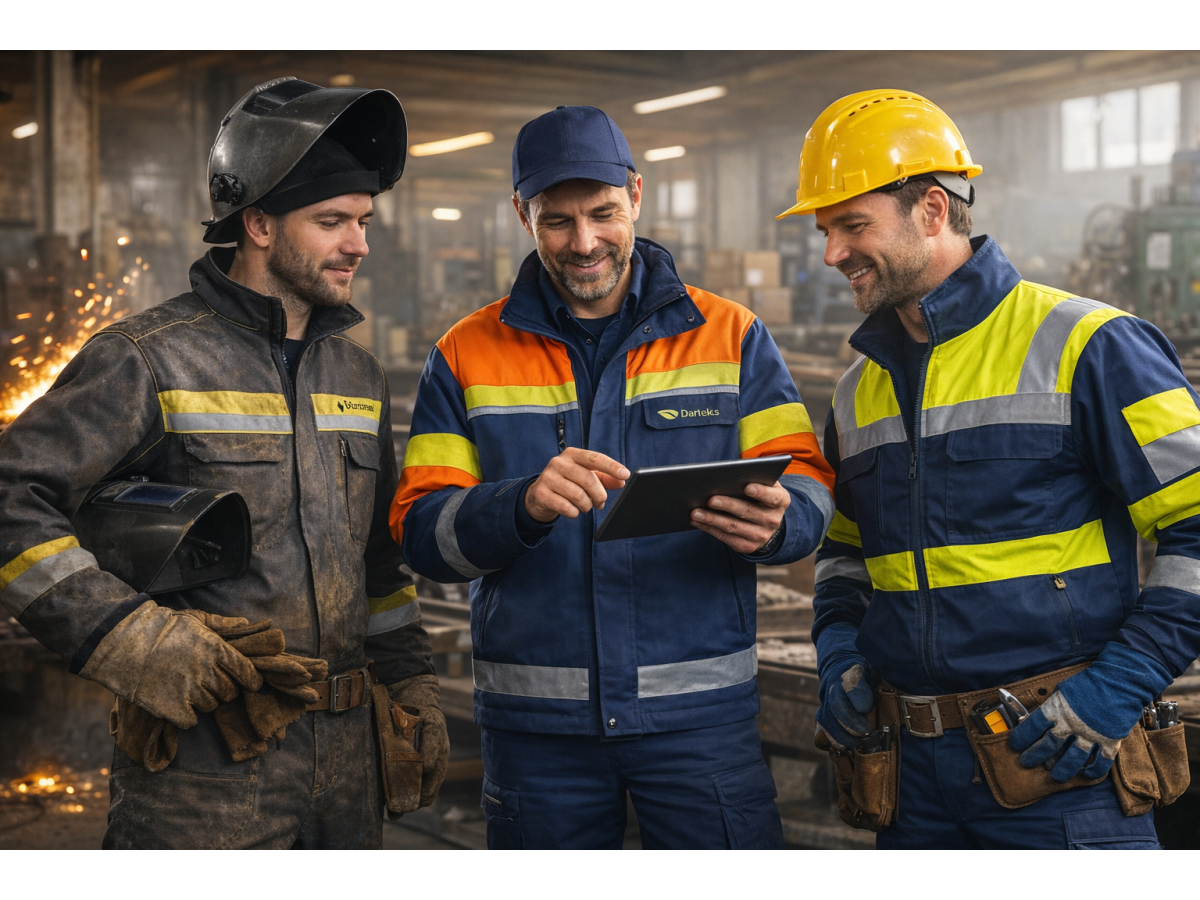
On a construction site or in a workshop, mistakes are costly - and workwear is often the first layer between a person and risk. When it comes to buying uniforms for the team or renewing your own kit, "European workwear" usually means one thing: predictable quality, a clear size grid and compliance with requirements that are not "at first sight", but verifiable.
This isn't a story about fashion. It's about why clothes last a season in some job segments and two or three in others, and why some purchases reduce downtime while others start to disappoint after the first wash.
What does “European workwear” mean in practice?
In professional language, it usually refers to products that are designed and manufactured according to European requirements: materials with a stable composition, understandable markings, a dimensional system that repeats from batch to batch, and clothing construction designed for the load. It is also important that safety clothing and certain occupational categories often require compliance with specific standards - especially for visibility, antistatic, flame resistance or food environments.
An important nuance: “European” in itself is not a magic guarantee. There are very strong manufacturers and there are mediocre ones. But the benefit is systemicity - it is easier to compare, re-order and standardize the team's form, because the descriptions and markings are usually more consistent.
European Workwear and Compliance: When “Comfortable” Isn’t Enough
For some jobs, durable trousers and a jacket that does not restrict movement are sufficient. In other industries, clothing is part of safety equipment, and then the procurement starts with a list of requirements, not color.
For high-visibility clothing, the placement of reflective strips and the brightness of the material are crucial to make the person visible from a distance and in different lighting conditions. For welders and hot work areas, clothing must reduce the risk of sparks, short-term exposure to flame and heat, and antistatic properties are often also required. In the food environment, hygiene and reducing the risk of contamination are crucial - HACCP logic requires clothing that can be washed regularly at appropriate temperatures and that does not accumulate dirt in the "pockets" of the design.
If a company is responsible for occupational safety, “just because it fits” is not the answer. Proper procurement reduces risk, simplifies training, and prevents situations where the site suddenly lacks appropriate clothing.
Materials and construction: where the “cheap” price advantage disappears
When buying workwear, the most money is usually spent not on the initial purchase, but on replacements. That's why it's worth understanding what exactly makes your clothes last longer.
Fabric composition affects both durability and comfort during shifts. Cotton is generally pleasant and breathable, but in some environments it dries more slowly and can “fatigue” more quickly. Polyester blends often hold their shape better, dry faster and are practical for intensive washing. The addition of elastane can provide freedom of movement, but this must be balanced with wear resistance - especially if the work is on the knees, with climbing, metal corners and regular friction.
The second layer is the construction. Reinforcements in the knees and seat area, high-quality zippers, seam reinforcements and places where the fabric is doubled often determine whether the pants “last” a season or a couple of months. The placement of the pockets is not a trifle - if the tools are with you all day, the pocket must withstand the weight and be where the hand finds it without looking. Here “it depends” on the job: for an electrician, organization and access are often important, in a warehouse - ease of movement and durability, in welding - safety and protection from heat.
Dimensional consistency and team standard
For companies that hire crews or rotate employees seasonally, the biggest benefit of a stable supply chain is repeatability. If the model and size grid are predictable, you can order a refill without a “measuring day” each time.
However, there are trade-offs here too. Choosing one style for the entire team simplifies purchasing and makes it easier to maintain inventory, but it doesn’t always work perfectly for all body types. A practical approach is to choose one line or manufacturer’s series, but allow 2-3 cut variations in one color, while maintaining an overall visual standard.
If identifiability is required in the work environment, logo prints or embroidery help with discipline and safety - it is easier to spot strangers, and the team looks unified even at client sites.
Examples of professions: how the requirements differ
In construction and assembly, wear resistance, freedom of movement and pocket logic are usually the main things. Knee inserts and reinforcements pay off when working on uneven surfaces or roads.
In logistics and warehouses, lighter clothing with breathable fabrics that do not hinder rapid movement often wins. If the work is outdoors or at loading ramps, layering is necessary - a vest or jacket that can be adjusted to the temperature while maintaining visibility.
In welding and industry, protection levels are crucial, as are details that reduce risk: concealed fasteners, spark-proof construction, and fabrics designed for hot work. Here, “cheap” often means frequent replacements or, in the worst case, an increased risk of incidents.
In food production and HoReCa, workwear works together with the process. If the uniform is easy to wash, retains its color and is properly covered, micro-risks are reduced and it is easier to comply with internal regulations. In medicine and care, on the other hand, comfort during long shifts, easy care and a professional appearance are important, which creates trust in patients.
Purchase side: delivery, returns and continuity
Workwear is often purchased “on a deadline.” The project has a start, the team has a schedule, and delays cost money. Therefore, speed of delivery and clear return policies are as important as the fabric.
For an individual buyer, the ability to return items means less risk if the size is not right. For a company, it means they can assemble kits faster and correct discrepancies without freezing their budget on the “wrong” sizes in the warehouse. Secure payments and quick customer support reach aren’t a bonus – they’re a way to prevent downtime.
If logo matching or specific changes to the model are also required, the supplier's ability to not only sell, but also actually fulfill the order in batches while maintaining quality becomes important. This is where companies often look for a partner, not a one-stop shop.
In practice, this can be provided by a supplier like DARTEKS , where you can complete workwear and PPE-oriented solutions for various industries in one place, while also getting fast delivery, secure payments, 30-day returns, and the ability to customize clothing or apply logos.
How to understand that the choice will be correct after three months
A good test is not just “does it work today”, but “will it be predictable tomorrow”. If the garment is heavily washed, the question is about color fastness and seam stability. If the work involves friction and tools, you should look at reinforcements and pocket durability. If there are safety requirements, you should look at the labels and whether the garment is designed for the specific environment, not a one-size-fits-all compromise.
Sometimes it's wise to buy in two tiers: a durable, comfortable base for everyday use, and a specialized set for risky work, used only on shifts when it's needed. This is not excessive if it reduces damage and the risk of incidents.
Workwear is not a place to “get by” at random. When the choice is based on requirements, material logic and supply predictability, European workwear becomes a simple tool: it allows people to work safer, faster and with fewer breaks - and that is what professionals value most.