
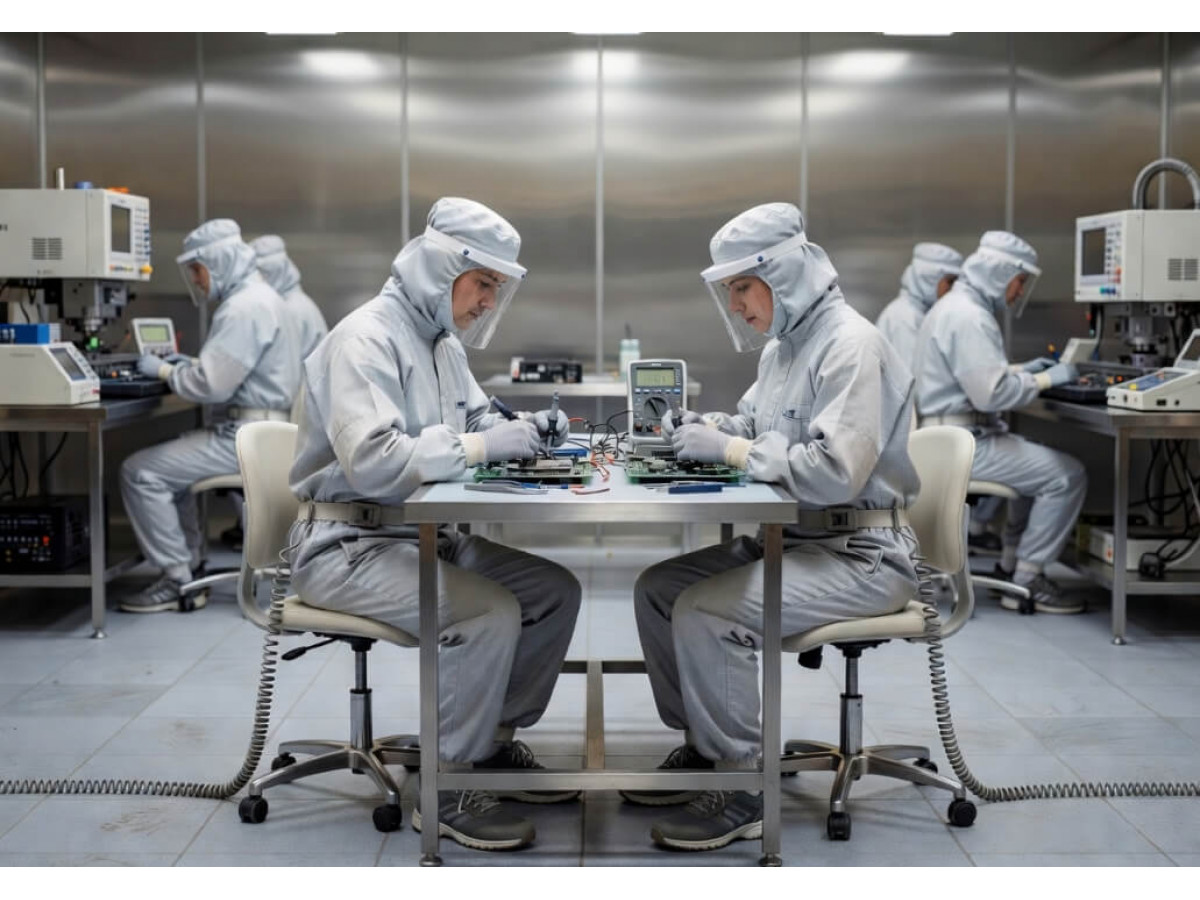
When a single uncontrolled spark in production is enough to damage an electronic component, stop a line or create a fire hazard, clothing is no longer just a uniform. Antistatic ESD workwear in such environments is an element of work safety and process stability, not an optional accessory. That is why the purchasing decision should be based not only on price, but also on compliance with the working environment, intensity of use and maintenance requirements.
Where antistatic workwear ESD is a must and should be taken seriously
ESD clothing is most often associated with electronics assembly, but in practice its use is broader. It is relevant in places where electrostatic discharge can damage sensitive devices, affect measurement accuracy, or become an additional risk factor in environments with flammable substances.
In manufacturing plants this applies to electronics, chip assembly, laboratories, automation assembly and quality control areas. In logistics this can be essential in warehouses where sensitive components are assembled and packaged. In chemical, pharmaceutical and certain industrial areas, antistatic properties are part of a wider safety system together with footwear, flooring and procedures.
It is important to note that not every piece of antistatic clothing is automatically a complete ESD solution for all scenarios. In some workplaces, a material that reduces static charge buildup is sufficient. In others, a complete set of ESD clothing and equipment is required, where each component works together.
What does ESD protection mean in practice?
Electrostatic discharge occurs when a stored charge is suddenly discharged. A person often does not even feel it, but a sensitive component can be permanently damaged. That is why ESD control is not just a matter of employee comfort. It protects the product, reduces scrap and helps avoid hidden defects that later turn into warranty costs.
Clothing has a specific function in this system - it helps control the formation and discharge of charge according to the requirements of the work environment. For this to work, it is not enough to have the right fabric. The cut, cuff solutions, quality of seams, type of closure and how the clothing is used in combination with other equipment also matter.
For example, an ESD jacket alone will not solve the problem if an employee is wearing the wrong underlayer or shoes. Therefore, companies that want real impact need to look at the entire system, not just one product in the catalog.
How to choose the right anti-static workwear for ESD environments
In procurement, mistakes most often occur when requirements are formulated too generally. The text “antistatic clothing is required” is not enough. It is necessary to determine what risk the clothing is intended for, how long it will be worn during a shift, what the temperature in the room is, and how intense the employee’s movements are.
Material and its stability in use
In ESD clothing, it is not only the initial fabric composition that is important, but also how stable the properties remain after repeated washing and daily wear. A cheap solution may seem advantageous at the time of purchase, but if the fabric loses functionality or shape after regular care, the overall costs increase.
In a production environment, fabric density and breathability should also be considered. Clothing that is too heavy will restrict movement and increase discomfort, while fabric that is too thin will not always withstand heavy use. The right choice is usually a balance between protection, durability, and wearing comfort.
The cut affects more than just appearance
Companies often focus on compliance with the standard but ignore whether the clothing is comfortable in everyday life. This is an expensive compromise. If employees keep their jackets open, take them off regularly, or choose the wrong size, ESD protection becomes less effective in practice.
Workwear should allow for freedom of movement, maintain a fit where needed, and not interfere with precise work. This is especially important on assembly lines, in laboratories, and in places where a person spends the entire shift at a desk.
A complete set, not individual items
If the work environment is strictly controlled, it is more appropriate to think of a set - jacket, trousers or gown, as well as appropriate footwear and other elements. This makes it easier to comply with standards, simplifies procurement and helps ensure the same level of protection for the entire team.
This is where companies benefit from a supplier who can provide not only individual sizes, but also serial assembly, repeat orders and stable quality. If the team is large or the staff turnover is high, this factor becomes very practical.
Common mistakes when buying ESD clothing
The first mistake is choosing only based on price. If the clothing wears out quickly, loses its shape, or is uncomfortable, the savings disappear in the first few months. The second mistake is an inappropriate size policy. If there are only a few universal sizes in the warehouse, part of the team will work in uncomfortable clothing, and this will affect both discipline and productivity.
The third mistake is to consider ESD requirements in isolation from the rest of the work environment. For example, if the room is hot, you should choose a fabric and style that you can wear for the entire shift without overheating. If the work is physically demanding, you need more freedom of movement and stronger construction in areas where the load is greatest.
The fourth mistake is not to foresee the circulation of clothing. ESD clothing is not a one-time purchase. The company needs a clear replenishment model, the ability to reorder the identical model and consistent quality control. Otherwise, after a few months, the team will have different models with different functionality.
Maintenance determines how long clothing will last.
Even high-quality ESD clothing will lose its value if it is not cared for properly. Therefore, during the procurement phase, it is necessary to evaluate not only the purchase price, but also the care regime. Does the company wash the clothing itself, or does it use an external service? Do employees have clear instructions? Is wear and tear controlled?
The frequency of washing, the temperature and the products used can affect the properties of the fabric. Therefore, clear information from the manufacturer about care and use cycle is important in a professional environment. This is especially important for companies that need to ensure consistent quality across shifts and departments.
In practice, this means a simple thing - clothing should not only be appropriate on the day of purchase, but also predictably functional after regular use. This is where the difference between formal suitability and real operational value becomes apparent.
Corporate image is also important in an industrial environment
Safety comes first, but a professional appearance is no less important. Uniform, neat and functional clothing helps maintain discipline in the workplace, strengthens the company's image in the eyes of customers and auditors, and makes it easier to identify employees in production areas.
For companies that combine ESD requirements with corporate identity, it is important to choose a supplier that is able to provide not only standard models, but also customizations - size gradation, logo application, serial repeatability and a stable delivery schedule. Darteks' advantage in such projects is production control and the ability to provide both a ready-made assortment and customized solutions for company teams.
When is a standard model enough and when is a customized solution needed?
For smaller teams or individual buyers, quality standard ESD clothing is often sufficient if the work environment is clearly defined and the requirements are not very specific. This allows for quick assembly of the required equipment and keeps costs under control.
Larger companies, multi-department production or teams with different work tasks often require a customized solution. For example, one part of the employees needs a lighter fabric for working in warm rooms, while another - a more durable model with additional functional pockets and fasteners. In such cases, developing an individual model is more rational in the long term than compromising with one universal option.
The key is to choose clothing based on the actual work situation, not a general description. If antistatic ESD workwear is aligned with the process, personnel habits and maintenance procedures, it works as a safety and productivity tool, not as a formal requirement in a folder. A good decision here usually means less scrap, more stable work discipline and a calmer everyday life for both the production manager and the safety specialist.