
How to procure and standardize safety clothing: a practical guide
If a crew has the same tools but different clothing, two things usually suffer: safety and discipline. In one facility, this means that a person is not visible enough, in another, that clothing burns from splashes or accumulates static. And most often, the problem appears not on the first day, but when the rhythm begins: shifts, washing, replenishment of the warehouse, new employees.
Safety clothing is not "just a uniform". It is work equipment that affects the risk of incidents, the well-being of employees, the pace of work and also the image of the company in front of customers. Below is a practical view - how to purchase and standardize safety clothing so that it works in real conditions, not just in a catalog.
What exactly is safety clothing and what does it cover?
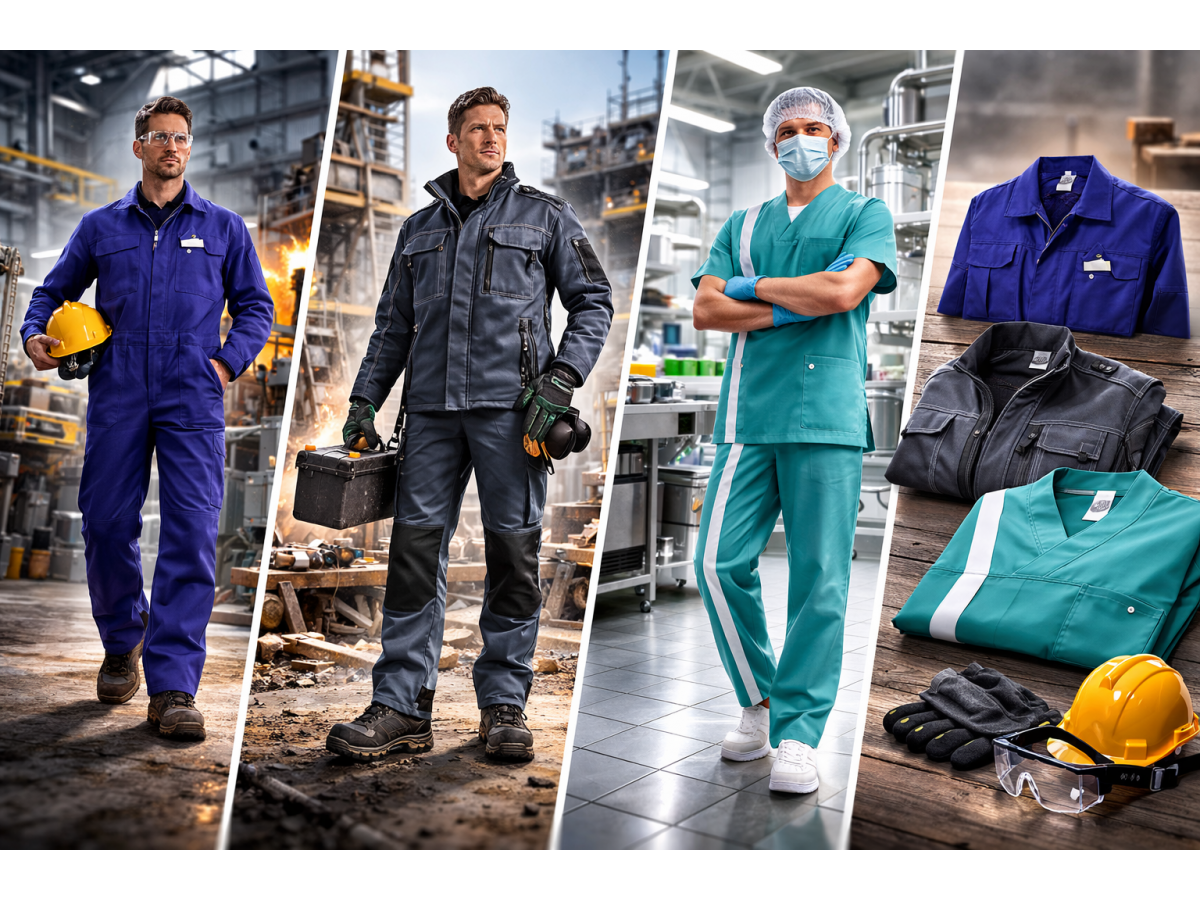
Safety clothing is a group of workwear where the main task is to reduce risks: improve visibility, protect against heat and flame, reduce electrostatic charge, protect against dirt and chemicals, ensure compliance with hygiene requirements. Depending on the industry, these can be hi-vis jackets and trousers , FR/antistatic sets for welders, and HACCP clothing for food production.
An important nuance in procurement — "safety" is not a single characteristic. For one employee, visibility in the dark and in the rain is primary, for another — protection against sparks and molten metal splashes, for another — cleanliness and easy disinfection. Therefore, the correct process begins with work environment scenarios, not with a model.
Start with risks, not color
If the choice is based only on "let it be orange and have reflective tapes", the result is usually overpaid or underpaid. It is practical to draw up a risk map for each role: who works outside, who near a heat source, who in dust, who in the food area, who in the warehouse with forklifts. Then safety clothing becomes a predictable set, not a compromise.
At the same time, it should be noted that the risk is not constant. In facilities with seasonal work, there will be different requirements in winter and summer. In the heat, the employee unbuttons, rolls up his sleeves, leaves his jacket in the car - so the clothing "on paper" may be appropriate, but in practice it is not worn. Here, the procurement must balance protection and wearability.
Visibility: hi-vis is not just a matter of a vest
In logistics, roadworks, warehouses and areas with transport, visibility is a basic requirement. Vests are often a quick solution, but not always the safest. If a person works in the rain, wind or with moving parts, a full hi-vis jacket or set that does not move or hinder movement works better.
There is also a trade-off here: the more layers, the harder it is to control exactly what is worn on top. If a dark jacket without reflective elements is worn under a hi-vis vest, the worker can only be seen from the front. Therefore, in practice, it is more efficient to standardize the top layer - a hi-vis jacket or a work jacket with reflective elements, and adjust the bottom layers to the season.
For welders and metalworkers: FR and antistatic as a system
Mistakes in the welding area are costly – both in terms of direct risk of injury and downtime. Fire-resistant (FR) and anti-static clothing is not just “thicker fabric”. It must work together with the rest of the equipment: gloves, apron, shoes, sleeves. If the clothing parts have open pockets or protruding elements, sparks can accumulate there. If the fastener is not protected, the heat can affect the very place where you most often put your hands.
An important purchasing detail is how often the garment will be washed and how. Some of the protective properties may depend on proper care, and industrial washing is a different regime than a domestic washing machine. If the team does not have a uniform care discipline, it is sometimes safer to choose a solution that is designed for intensive use and retains its properties after repeated washings. The relevant European standards in this category are EN ISO 11612 (protection against heat and flame) and EN 1149 (antistatic properties).
For food and hygiene: HACCP clothing is not "sterile" but controllable
In food production and HoReCa clothing, the challenge is to reduce the risk of contamination and ensure a controllable hygiene regime. This means simple, lockable parts, predictable color coding by zone, fabric that withstands frequent washing and retains its shape. In some production facilities, it is also critical that the clothing has minimal "putt" and that parts (such as buttons) do not get lost in the product.
Here "it depends" is about the workflow. If employees move between zones, it is worth thinking about a clear set system and spare clothes on site. If everyone brings home and washes them themselves, control will be weaker - and the requirements actually become more difficult to meet.
Comfort and ergonomics: safety that can be worn for 10 hours
In practical terms, comfort is not a bonus. If the pants are tight at the waist, if the fabric doesn't breathe, if the knee area wears out quickly, a person changes their habits: they move differently, stop more often, and get tired faster. Productivity drops and the number of errors increases.
In everyday life, the biggest difference is made by the cut, reinforcements and small details - elastic inserts in movement areas, reinforced knees, pocket placement that does not interfere, and the choice of fabric for a specific season. The right approach is a seasonal set, not one universal version of trousers all year round.
A procurement process that reduces errors
For safety clothing to be predictable in cost and results, procurement should be similar to tooling — with standards and replenishment logic.
First, define the roles and the minimum set for each role. Then agree on the fabric and details that are "must haves". Then create a size matrix: size samples, fitting and fixing, so that after 3 months a new employee does not have to order three options and return two.
The biggest stumbling block is serial replenishment. That's why it's worth choosing a supplier from the start who can ensure repeatability - the same models, the same fabrics, and predictable execution.
Corporate image: a logo is not decoration, but identification
In the work environment, logos and personalization serve a practical function: identification on site, clear affiliation with the subcontractor, a uniform visual standard in front of customers. A practical approach is to standardize the placement and technique (e.g. embroidery or thermal transfer) and plan spare units without personal names. If you change personnel frequently, opting for only the company logo is often more economically sound.
How to understand that the price is "right"
In workwear, the cheapest is rarely the cheapest after 6 months. Look at the cost over the wear period: how long the trousers last, how quickly the knees rub, how often the zipper breaks, how much downtime costs while waiting for a replacement. Clothing that is too "heavy" can slow down the pace of work - so the right price is one that corresponds to the specific job and season.
Where to look for a one-stop solution
If you need both a ready-made catalog and the ability to agree on the model, fabric, logo application and regular replenishment, it is valuable to work with a manufacturer who controls the process. If you are looking for an approach where you can assemble both hi-vis, FR/antistatic, and HACCP clothing, as well as organize printing or embroidery and repeat orders, you can do it in one flow at darteks.eu — from selection to delivery.
Workwear rarely becomes a problem the moment you choose it. It becomes a problem after it starts to be worn, washed and replenished intensively. When safety clothing is selected based on real risks and with a clear replenishment logic, you gain not only protection but also peace of mind in your daily operations.
Frequently Asked Questions (FAQ)
What is the difference between a hi-vis vest and a hi-vis jacket? A vest is a quick solution, but it can move around in the rain or wind and does not provide full visibility from the sides and back. A jacket with reflective elements is more stable and safer in intensive work environments.
Is FR clothing suitable for everyday work? Yes, modern FR fabrics are comfortable enough for everyday use. The key is to choose the right weight and cut for the specific job and season.
How often should HACCP clothing be replaced? It depends on the intensity of washing and the quality of the fabric. High-quality HACCP clothing can withstand 50–100 industrial washings, maintaining its shape and hygienic properties.
Can I order clothing with a company logo? Yes — darteks.eu offers both embroidery and thermal printing. It is recommended to standardize the placement of the logo and avoid applying personal names to facilitate clothing rotation.
How to calculate the correct size matrix for a team? It is recommended to try on the size samples before confirming the order. This saves time and reduces return costs.