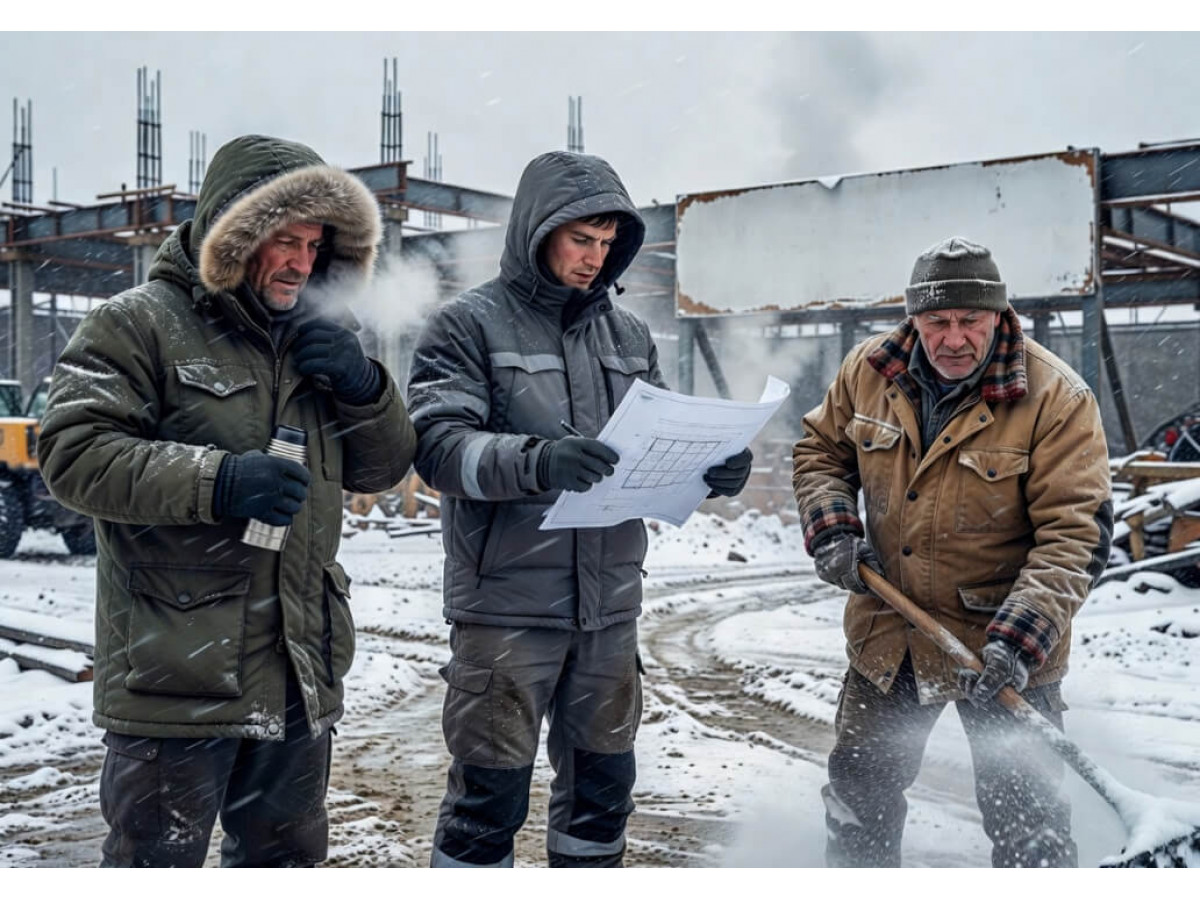
A morning shift in the cold quickly reveals whether a jacket is a work tool or just another layer of clothing. If your shoulders are cold, your back is sweaty, and your pockets are not holding anything in place, your work becomes slower, more uncomfortable, and often less safe. That's why the best work jackets for cold weather aren't just about looks - they directly impact your productivity, concentration, and ability to work a full shift without unnecessary discomfort.
This choice is especially important for companies that equip crews in construction, logistics, manufacturing, warehousing and outdoor maintenance. An incorrectly selected jacket not only means dissatisfied employees, but also more wear, more frequent replacements and unnecessary costs. On the other hand, a correctly selected model lasts longer, meets the specific working conditions and helps maintain a unified professional image.
How to understand which are the best work jackets for cold weather
There is no one-size-fits-all jacket. A warehouse picker who works on a ramp and regularly moves between indoors and outdoors needs something different than a road construction crew or a welder on an open site. That's why it's important to consider not just the thickness, but the overall work environment.
The first criteria are temperature and wind. Dry cold without strong winds requires one solution, but wet cold with drafts requires another. A jacket that works well at -5 degrees in dry weather may not be sufficient on a windy construction site at zero.
The second criterion is the intensity of movement. An employee who walks a lot, lifts, climbs and changes position regularly will quickly overheat in a jacket that is too thick. This means sweating, humidity and an even greater feeling of cold after a short time. On the other hand, for those who stand still for a long time or work at a slower pace, thermal insulation should be more serious.
The third criterion is the occupational risks. If increased visibility is required at the site, a standard dark winter jacket will not work. If there is contact with sparks, flame or an electrostatic environment, specialized solutions with appropriate protective properties should be considered. Cold is not the only factor.
Material and insulation - where the real difference begins
In practice, the biggest mistake is to focus only on the lining. A warm lining is important, but the outer fabric and construction determine how long that warmth lasts. If the outer layer quickly lets wind or moisture through, even a thick jacket loses its effectiveness.
A durable outer fabric is important in construction, manufacturing and service, where the jacket is regularly exposed to rough surfaces, tools and machinery. There is no point in choosing a model that will start to tear after one season. Workwear must withstand repeated use, washing and daily stress.
When it comes to insulation, balance is key. A jacket that is too light will not protect you in prolonged cold, while a jacket that is too heavy and stiff will restrict your movements. The best models usually combine sufficient thermal insulation with an anatomical cut so that a person can work freely, bend, raise their arms and move without a constant feeling of pulling in their shoulders.
Breathability should also not be ignored. If the jacket completely seals out moisture inside, comfort is lost even if it is not very cold outside. Therefore, companies purchasing workwear for crews should consider not only “warm or not warm”, but “warm for a specific work mode”.
The most important details that affect everyday work
The quality of a cold-weather work jacket is often determined not by the advertising description, but by the little things that show themselves in the first week. A collar that covers the neck well, a hood that can be used with or without a helmet, and cuffs that keep the wind out are not optional extras - they are functional requirements.
Pocket placement is also important. If an employee often needs a phone, map, notepad, or small tools, the pockets should be secure and easily accessible with gloves. Poorly placed pockets slow down the work pace and cause unnecessary annoyance throughout the shift.
A two-way zipper, reinforced seams, an extended back and an adjustable hem are details that directly affect the service life and comfort. They are especially appreciated by workers who often sit in machinery, climb into transport or work in a bent position. A jacket that constantly opens or rides up quickly becomes a problem.
When you need a hi-vis, FR or other specialized jacket
Not all of the best work jackets for cold weather are simply insulated winter jackets. In many industries, protection from the cold is only one of the criteria. Construction sites, road works and logistics often require a high-visibility jacket with reflective elements to ensure the worker is visible even in poor lighting and early morning hours.
In metalworking and welding, a standard polyester jacket may not be suitable, even if it is warm. There, compliance with fire safety or antistatic requirements is more important. In food production and HoReCa environments, on the other hand, not only warmth should be considered, but also cleanliness, ease of care and compliance with the requirements of the specific work area.
This means one simple thing - shopping based on price alone doesn't tell you if a jacket will be right. If the model doesn't fit the work environment, the savings disappear very quickly. You have to buy again, change models, or address safety and compliance issues after the fact.
One jacket for the whole team or different models
From a procurement perspective, a single model seems like a convenient solution for everyone. It simplifies ordering, accounting, and visual identity. However, in practice, it is not always the smartest option, especially in larger teams with different responsibilities.
For example, warehouse workers, drivers, and an outdoor assembly crew can all share the same corporate visual identity but have different insulation levels or functionality in their jackets. This maintains corporate unity without forcing everyone to work in the same conditions and wear the same clothing.
Dimensional stability and continuity of supply are also important here. If a company plans to replenish regularly, it is important that the selected model is available in series and can be reordered without fluctuations in quality. That is why many companies choose to cooperate with a supplier that is able to ensure not only a one-time sale, but also long-term supply and personalization.
How to avoid the most common mistakes when choosing
The most common mistake is buying a jacket that is too warm for active work. At first, it seems like a safe choice, but after a few hours, the worker is hot, wet and tired. As a result, the jacket is left open, removed or worn incorrectly, and the protective effect is lost.
The second mistake is to underestimate the impact of wind and humidity. Sometimes a company chooses a cheaper insulated model that is suitable for a dry winter, but not suitable for an open object. In such a situation, discomfort appears very quickly, especially in the shoulder, chest and back areas.
The third mistake is to ignore layering. A jacket alone does not solve everything. If there is inappropriate, sweat-wicking clothing underneath, even a good outer jacket will not be able to provide proper comfort. Therefore, in cold weather, the workwear system should be considered together - base layer, mid layer and top layer.
The fourth mistake is to think that all employees will use their jackets the same way. In real work, some keep the zipper closed all the way, others open it often, some move more, others stand for longer. Therefore, a good jacket is not only warm, but also adaptable to a specific use.
What to ask the supplier before ordering
If you are purchasing work jackets for a team, it is not enough to just look at the photo and price. It is worth finding out exactly the fabric composition, insulation level, intended use and care conditions. Also ask about available sizes, regularity of the model and whether re-delivery is possible during the season.
Personalization is also important for companies. Printing or embroidering a logo on a winter jacket is not just a matter of image. It helps identify the team on site, strengthens the visual unity of the company and leaves a professional impression on customers and partners. If the supplier is able to provide both production and customization, the process becomes significantly more efficient.
This is where a manufacturer with practical experience in the workwear segment has a big advantage. For example, Darteks' approach is based on working conditions, not just a catalog. This is essential for companies that need consistent quality, understandable deadlines and the ability to assemble clothing for different positions in one system.
A proper winter jacket doesn't interfere with work and doesn't make you think about yourself all day long. That's exactly what's good about it - a person focuses on work, not on the cold, wind, and discomfort.